Move $10,000 of emergency savings from a big-bank account paying 0.01% into a high-yield savings account paying 4.0%, and your annual interest jumps from about $1 to roughly $400. That twenty-minute decision captures the gap between how saving is described and how saving systems actually perform. Many people assume saving is simply setting aside a fixed amount and watching it grow; the reality involves irregular paychecks, surprise repair bills, apps promising effortless wealth, and plain human psychology. This article unpacks the most common beliefs about saving systems and tests them against the lived experience of households trying to build financial security through 2025 and 2026.
Common Assumptions About Saving That Don’t Always Hold Up
The most prevalent assumption is that saving is a linear process tied to disciplined budgeting: paycheck arrives, a fixed slice moves to savings, the rest covers bills and discretionary spending. The national numbers tell a different story. The personal saving rate — the share of after-tax income households do not spend — has hovered in the low single digits in recent years, roughly 3 to 5 percent, well below the 7 to 9 percent typical a generation ago. Surveys also keep finding that roughly four in ten households would struggle to cover a $400 surprise expense with cash on hand. Paychecks can be irregular, emergencies keep their own schedule, and framing saving as a pure test of willpower misses all of this.
Another durable belief holds that a traditional savings account at a familiar national bank is the best home for an emergency fund because it is safe and always accessible. Safety is real: federal deposit insurance protects up to $250,000 per depositor, per bank, per ownership category, which means depositors are made whole even if the bank fails. Yield is another matter. The largest banks still commonly pay under 0.5 percent — often just 0.01 to 0.05 percent — while online high-yield savings accounts, the same insured product offered by banks without branch networks, have recently paid roughly 3.5 to 4.5 percent APY (annual percentage yield, the yearly interest rate after compounding). With consumer prices rising about 2.5 to 3.5 percent a year, down from a peak near 9 percent in mid-2022, a near-zero account quietly loses purchasing power every year, while a high-yield account roughly keeps pace with inflation or slightly beats it. Households end up caught between convenience and yield.
How this can look in practice
Consider a single parent working two part-time jobs whose combined take-home pay swings between about $2,400 and $3,300 a month. A fixed $250 monthly transfer fails in lean months and triggers guilt, or worse, overdrafts. A percentage rule bends instead of breaking: setting aside 4 percent of every paycheck means roughly $96 leaves in a slow month and $132 in a strong one. The habit survives, the checking account never goes negative, and after a year there is around $1,300 set aside that a rigid plan would never have produced. Car repairs and medical bills still land — the difference is that the system absorbs them.
How Technology Is Changing Saving — And Where It Falls Short
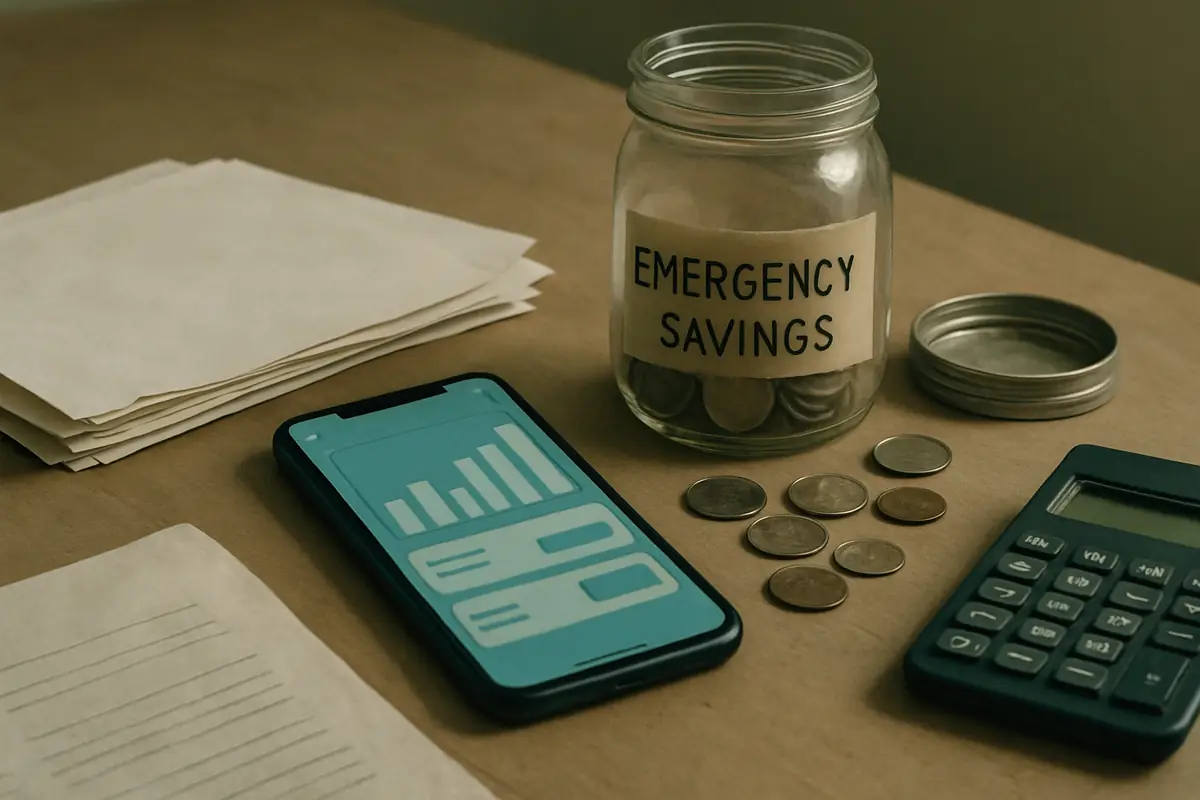
Financial technology promises to strip friction out of saving: automatic transfers on payday, round-ups that sweep spare change (a $4.30 coffee purchase becomes $5.00, with the 70 cents moved to savings), and goal trackers built into everyday banking apps. The mechanics genuinely work. Typical round-up users accumulate $30 to $50 a month — $360 to $600 a year — without feeling it. Scheduled transfers do more: $25 to $50 a week compounds to roughly $1,300 to $2,600 a year. The arithmetic is worth walking through once, step by step. Step one: suppose take-home pay is $3,600 a month and you automate $40 every Friday. Step two: over 52 weeks, 52 × $40 = $2,080 in deposits. Step three: parked in a high-yield account at 4.0 percent APY, the growing balance averages roughly half the year-end total, so about $1,040 × 0.04 ≈ $42 of interest in the first year — call it $2,122 in total. Step four: the identical routine in a 0.01 percent big-bank account earns about a dime. Step five: in year two, the existing $2,122 alone generates another $85 before a single new deposit. Automation plus a competitive rate turns pocket change into a four-figure cushion.
What technology cannot do is stretch the paycheck itself or smooth a volatile income. And for many users, sophistication breeds confusion rather than clarity: three linked accounts, streak notifications, and tiered bonus rates that require a $5,000 minimum balance or 15 debit swipes a month to unlock the advertised number. Understanding all of it takes time and attention — commodities busy households often lack. What looks like streamlined automation from the outside can become digital noise that adds to financial stress instead of reducing it.
The Myth of Perfect Budgeting Versus Real Household Trade-offs
Personal finance culture loves the idea of the perfect budget — every dollar categorized, income and outflow balanced to the penny. The most popular template, the 50/30/20 rule, directs 50 percent of take-home pay to needs, 30 percent to wants, and 20 percent to savings and debt payoff. It is a useful benchmark, but in many metro areas rent alone absorbs 40 to 50 percent of take-home pay, and real spending refuses to sit still: quarterly insurance premiums, back-to-school runs that cost families $600 to $900, holiday spending, and the familiar pattern of treating yourself during a stressful stretch. Rigid budgets crack along exactly these lines.
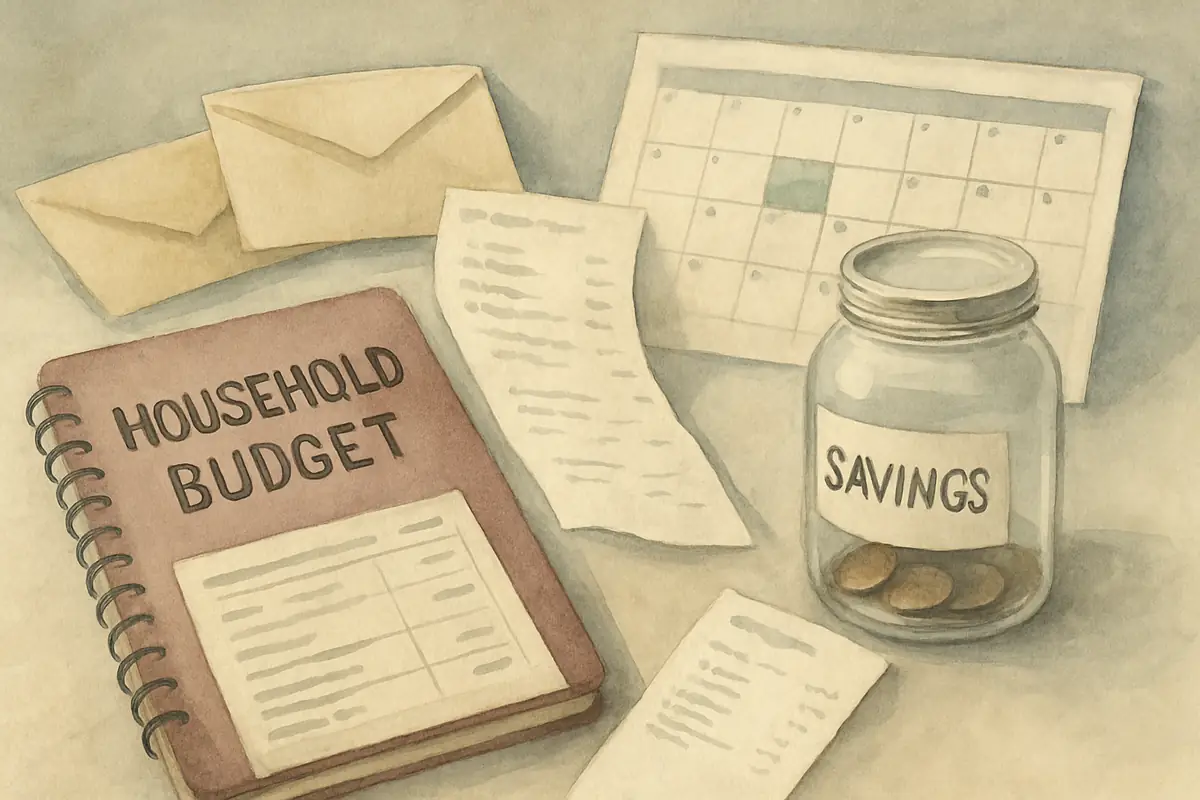
Accepting an imperfect budget means naming the trade-offs out loud. One practical tool is the sinking fund — a small dedicated bucket you fill monthly ahead of a known, irregular bill. Setting aside $75 a month for twelve months meets a $900 auto insurance premium without a December scramble. Sometimes the right call is saving less for a season to protect mental health or fix the leaking roof; other times it means tightening early because a big known expense is six months out. Financial planning shifts from strict rules to adaptable frameworks that expect real life to intrude.
Payment Timing
Schedule transfers for the day after each paycheck lands rather than a fixed calendar date. A mistimed $100 transfer can trigger a $25–$35 overdraft fee — enough to erase months of interest earnings.
Emergency Fund Layers
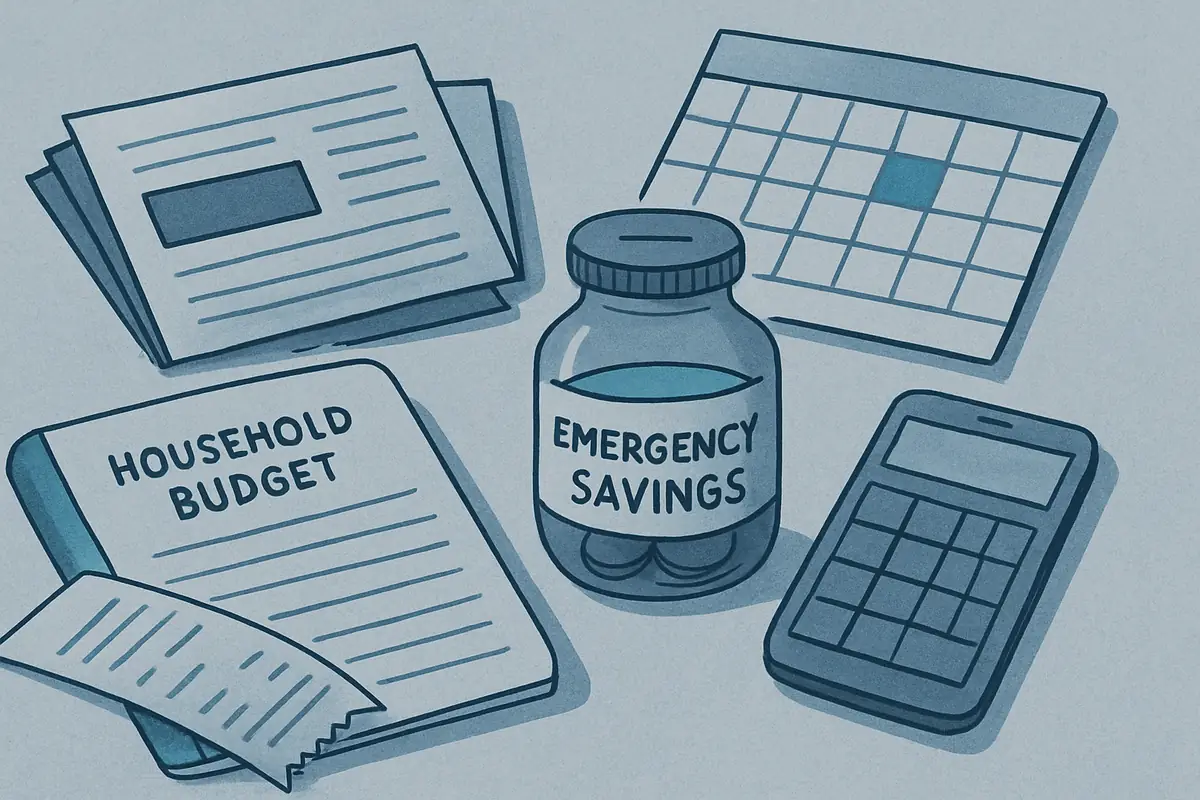
Keep a first tier of $500–$1,000 in instant-access cash for urgent repairs, and build a second tier of three to six months of essential expenses in a high-yield account earning 3.5–4.5 percent.
Digital Tools Use
Choose apps that sync automatically but allow manual pauses and transfer caps. Turn off every alert that is not actionable; notification fatigue is a quiet reason people abandon otherwise good tools.
Historical Perspectives: How Saving Systems Have Evolved
Saving has traveled a long arc over the past century: from cash under the mattress to passbook accounts stamped by a teller, to the Christmas club accounts of the mid-1900s in which $5 deposited weekly from January produced about $250 by December, to payroll direct deposit becoming standard through the 1980s and 1990s, and finally to mobile apps that round up purchases and display progress bars toward a named goal. Each step moved money with less physical effort — tools unimaginable to a Depression-era saver stashing bills in a coffee tin.
Yet many households still run manual systems shaped by habit and trust: cash envelopes for weekly groceries, separate jars for utilities versus fun money. Lending circles remain a striking example — informal groups, commonly ten members each contributing $100 a month, with every member taking the $1,000 pot in turn. The structure is centuries old and still helps households with thin credit files assemble lump sums today. These mixed systems reflect an ongoing tension between traditional practices grounded in personal trust and digital conveniences that promise efficiency but demand new kinds of literacy before they pay off.
Warning Signs: When Saving Systems Become Stress Traps
Where readers should be careful
Automated tools withdraw on schedule regardless of what is actually in the account, and each bounced transaction can cost $25–$35 in fees. Rigid savings rules that ignore life’s unpredictability produce guilt when goals slip — and guilt is a poor foundation for a durable habit. Test any new system against your worst recent month, not your best, before adopting it wholesale.
Households under sustained pressure often develop saving fatigue — the emotional exhaustion of repeatedly trying to put money aside while setbacks keep arriving. The backdrop matters: overall consumer prices have climbed more than 20 percent since 2020, with groceries, rent, and insurance leading the way. When every attempt to build a cushion gets consumed by the next bill, people reasonably stop trying — unless the system itself is built to flex during bad stretches instead of punishing them.
Gamified saving cuts both ways: streaks and progress meters motivate some users; for others, the same metrics feel like judgment in months when priorities must shift away from saving. A tool that celebrates a 40-week streak can also make week 41 — the week of the furlough — feel like personal failure rather than ordinary bad luck.
How this can look in practice
Imagine a couple running a round-up app plus a $25 weekly auto-transfer. A job furlough cuts household income by about 30 percent for six weeks. Before they locate the pause setting, the automatic withdrawals push checking into overdraft three times at $35 each — $105 in fees, more than the app had swept into savings that entire month. The tool designed to reduce money stress became its main source.
Practical Realities: Timing Your Savings Around Life's Unpredictability
Successful systems tend to be built around each household’s actual timing cycles rather than an idealized monthly grid: when paychecks arrive, when bills cluster (often the first of the month), which seasons run expensive, and which known events — school fees, tires, a deductible — sit on the horizon. Anyone paid biweekly, for example, gets two "three-paycheck months" every year; treating those as scheduled surplus windows can fund a sinking fund or emergency tier almost painlessly, since that money was never woven into the monthly routine.
Acknowledging cycles also means building buffer zones — extra reserves banked ahead of big known expenses, with a common target of one month of core expenses sitting in checking as a shock absorber. Contributions can flex with the calendar: 6 percent of income in surplus months and 2 percent in tight ones beats a rigid 4 percent that collapses twice a year. The classic three-to-six-month emergency fund is best treated as a range with milestones, starting with a first goal of $1,000, rather than a pass–fail exam.
The Pros and Cons of Emerging Saving Approaches
A quick comparison clarifies the trade-offs. High-yield savings accounts pay roughly 3.5 to 4.5 percent, stay fully liquid, and carry deposit insurance — but the rate can drop any time the bank chooses. Certificates of deposit, or CDs — accounts where you lock a fixed sum for a set term in exchange for a guaranteed rate — have paid roughly 4 to 5 percent, with the catch of an early-withdrawal penalty that often equals three months of interest. Treasury bills — short-term federal government IOUs maturing in 4 to 52 weeks — yield a similar 4 to 5 percent, and their interest is exempt from state income tax. Round-up apps are painless but small-scale; newer blockchain-based options advertise more but carry real risk. Each approach trades among yield, liquidity, and simplicity, and sensible households usually blend two or three.
Technological Innovations Driving Saving Systems
The evolution of saving systems is tightly linked to technological progress. Artificial intelligence, machine learning, and blockchain are reshaping how people approach and manage savings. AI-powered tools now analyze spending in real time and generate personalized recommendations matched to a person’s goals and risk tolerance — the kind of tailored guidance that once required a human advisor charging around 1 percent of assets per year, now bundled into banking apps for free or a few dollars a month. Blockchain adds transparency and security to some platforms, letting users verify where funds sit while reducing certain fraud risks. Together these tools make systematic saving practical for people who never had access to professional advice.
Integration into mobile apps has done the democratizing. Applications can automatically round up purchases and route the spare change into designated buckets — an emergency tier, a vacation fund, a diversified portfolio — so accumulation happens passively. That matters psychologically: the burden of deciding to save, again and again, is exactly where most manual systems fail. As these tools absorb lessons from behavioral economics, they increasingly time their prompts and adjust their targets to fit each user’s patterns, which raises the odds that the habit survives contact with a hard month.
The frontier includes decentralized finance, or DeFi — savings and lending services that run on public blockchain networks instead of banks. These platforms advertise yields of 5 to 10 percent or more through peer-to-peer lending and staking — pledging digital tokens to help operate a network in exchange for rewards. The trade-offs are serious: there is no $250,000 deposit-insurance backstop, smart-contract code can contain exploitable bugs, and the regulatory picture keeps shifting. For most households, DeFi belongs — if anywhere — as a small satellite around a conventional core, never as the emergency fund itself.
Behavioral Economics and Personalized Saving Incentives
Behavioral economics addresses the psychological barriers that quietly sink saving plans. Traditional methods feel tedious and abstract, which invites procrastination and inconsistent deposits. Modern systems counter this with personalized incentives: gamified points and badges for hitting milestones, and commitment devices built on loss aversion — the well-documented tendency for a $100 loss to sting roughly twice as much as a $100 gain pleases. Some platforms let users stake a small pledge against their own goal; the prospect of losing even $20 motivates far more reliably than the prospect of earning it.
Personalization extends to communication. Automated nudges flag upcoming bills, suggest a $10 bump to the weekly transfer after a flush month, and go quiet during documented hardship. By pairing transaction data with timing analysis, systems learn when a saver actually responds to a prompt — payday morning, not bill-due evening — and schedule engagement accordingly. The cumulative effect shrinks the number of active decisions saving requires, turning a recurring act of discipline into a background process that occasionally asks for a yes.
Social features add another layer. Group challenges make goals communal — the popular 52-week ladder starts at $1 in week one and ends at $52 in week fifty-two, totaling $1,378 — and workplace or family savings pools create gentle accountability that counters impulsive spending. Future versions will likely push into more interactive, even immersive formats blending education with entertainment.
Sustainability and Ethical Considerations in Saving
As environmental and social awareness grows, sustainable finance is shaping where people park their money. Platforms increasingly offer green bonds — bonds whose proceeds fund climate and clean-energy projects — alongside social impact funds and portfolios screened on ESG criteria, shorthand for environmental, social, and governance: a lens for judging how a company treats the planet, its people, and its own oversight. These options let savers pursue growth and impact simultaneously, a pairing younger savers increasingly expect as a baseline.
Transparency about allocation is becoming the differentiating feature. Next-generation services report what deposited dollars actually funded — community lending, renewable capacity, affordable housing — rather than asking users to take the label on faith. That reporting builds trust, and it pressures institutions: when customers can see where pooled savings flow, banks have a commercial reason to manage the money conscientiously.
The hard part is keeping ethics and returns aligned. Screened portfolios must stay competitive without diluting their standards, and the industry’s recurring failure mode is greenwashing — marketing that overstates a product’s environmental benefit. Guarding against it takes verification data, vigilant risk management, and product design that survives scrutiny; collaboration among providers, regulators, and savers will determine whether sustainable saving becomes a durable framework or a passing label.
Integrating Artificial Intelligence in Personalized Savings
Artificial intelligence is positioned to replace one-size-fits-all advice with genuinely dynamic saving plans. Algorithms can read individual spending patterns, income swings, and stated goals, then adjust targets on the fly — trimming a $300 monthly goal to $150 in a high-expense month, and quietly raising it again when cash flow recovers. Predictive analytics goes further, flagging likely future costs — an aging car, a rising insurance premium — so users prepare before the bill arrives. For a household with variable income, that adaptability is the difference between a plan that survives a year and one abandoned by March.
Beyond budgeting, AI-driven tools can simulate scenarios across different vehicles — high-yield accounts near 4 percent, CDs, short-term Treasury funds — and suggest reallocations matched to rate conditions and personal risk tolerance. This is especially valuable for younger savers with long horizons and lumpy incomes, who benefit most from small optimizations compounded over decades. Because the models refine themselves with each interaction, guidance improves over time — better advice produces better habits, which produce better data for the next round.
The Role of Behavioral Economics in Enhancing Saving Systems
Designing effective saving systems means abandoning the fiction of the perfectly rational saver. Real behavior bends under procrastination, loss aversion, and mental accounting — the habit of treating dollars differently depending on which bucket they sit in, which is why a $500 tax refund gets spent while a $500 paycheck slice gets saved. The most powerful counterweight is the default: workplace plans that automatically enroll employees at 3 percent of pay and escalate contributions by 1 percentage point a year toward a 10 to 15 percent cap consistently produce far higher participation than plans requiring an active opt-in. Pre-commitment devices — deciding today that half of any future raise goes to savings — beat inertia by harnessing it.
Gamification and real-time feedback keep the effort visible: milestone rewards, progress toward a named goal, and optional social sharing turn an abstract balance into a running story. Seeing the emergency fund cross $1,000, then one month of expenses, then three, sustains motivation in a way an annual statement never could. These psychologically informed techniques let platforms do more than track money — they shape habits, which makes long-term planning achievable even for people who would never describe themselves as disciplined.
The Impact of Blockchain Technology on Saving Systems
Blockchain offers concrete enhancements in transparency, security, and access. By decentralizing record-keeping and validating transactions cryptographically, it makes records immutable and verifiable without a central authority, which can trim intermediary fees and shorten settlement times. Smart contracts — self-executing code that moves money when preset conditions are met — enable programmable discipline: funds that release only when a goal balance is reached, or deposits locked until a chosen date, functioning like a digital CD without the bank in the middle.
Tokenization extends the idea: dividing an asset into digital shares so a saver can hold $50 of something that once demanded $50,000 minimums, diversifying with small outlays while retaining liquidity through exchanges. Ledger transparency can even help regulators monitor compliance without exposing individual identities. The caveat stands, though: assets on these platforms sit outside the $250,000 deposit-insurance system, so they belong in the risk-bearing portion of a household’s plan, never the emergency fund.
Sustainability and Socially Responsible Saving Options
Savers increasingly want money to grow and to matter. Platforms respond with options weighted toward green bonds, renewable-energy projects, and companies meeting strict environmental, social, and governance standards. The appeal is strongest among younger savers, many of whom treat that alignment as part of overall well-being rather than separate from it.
Making the promise real requires verification. Robust data sources and independent checks separate genuine impact from greenwashing, and advanced analytics let users track the estimated footprint of their holdings in near real time. That accountability turns good intentions into informed decisions — savers see what their dollars support while the balance compounds.
Financial Literacy as a Cornerstone for Evolving Saving Systems
No matter how capable the automation becomes, foundational literacy remains the load-bearing wall. Future systems need built-in education scaled to the user’s starting point: how compound interest — earning interest on previously earned interest — actually behaves, why inflation quietly taxes idle cash, how different account types are taxed, and what diversification protects against. The numbers make the case vividly: money earning 4 percent doubles in roughly 18 years, while money earning 0.5 percent takes well over a century — a gap no app notification can substitute for understanding.
Learning by doing closes the loop. Simulations and scenario tools built on a user’s real numbers turn abstract concepts into visible outcomes: what happens to the emergency fund if the car dies in March, what an extra $20 a week becomes in five years. That literacy builds warranted trust — users who understand why an algorithm recommends a transfer follow through more consistently and hold their plans through downturns and life changes. Higher knowledge, in the end, converts every tool in this article from novelty into system.