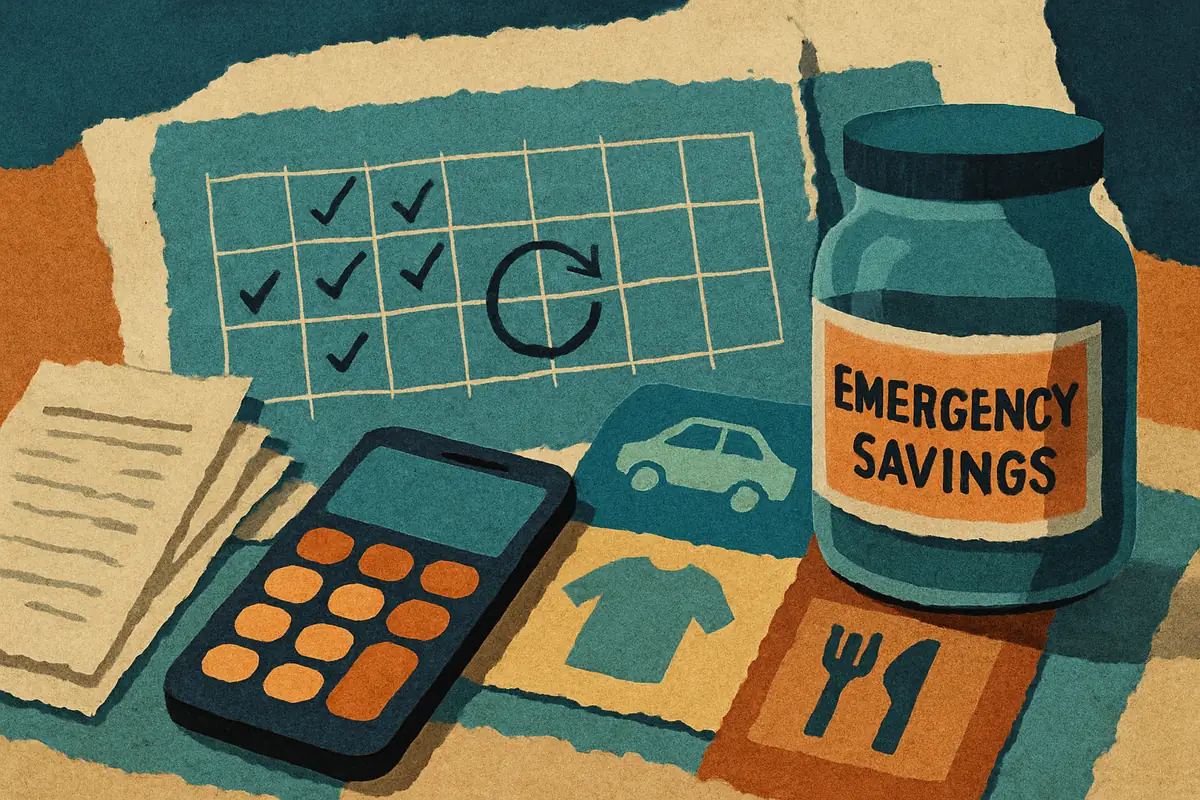
Roughly four in ten American adults say a surprise $400 expense—a blown tire, a cracked molar, a furnace repair—would force them to borrow, sell something, or leave another bill unpaid. Yet many of those same households describe their finances as stable. That gap between felt security and measurable capacity is what this article unpacks: why financial resilience sometimes masks fragility, and how everyday decisions about where cash sits, how debt gets paid, and when income actually arrives shape the true picture behind the numbers.
Financial Resilience Can Look Strong While Hiding Real Risks
On paper, a household with $12,000 in savings and two steady paychecks looks secure. It absorbs a delayed reimbursement or an unexpected $300 bill without drama. But resilience decays quietly. If that $12,000 sits in a traditional branch savings account paying under 0.5% interest while consumer prices climb 2.5% to 3.5% a year—the range U.S. inflation has occupied through much of 2025 and 2026—the fund silently loses roughly $250 to $350 of purchasing power every twelve months. Moving the same balance into a high-yield savings account, meaning an online savings account that pays several times the interest of a typical branch bank, at 3.5% to 4.5% roughly keeps pace with prices. Same dollar amount, very different trajectory.
Concentration is the other quiet risk. A family living on one $75,000 salary can look identical, month to month, to a family living on three income streams totaling the same amount—until the single source falters. Households in this position also tend to defer protective spending: skipping a $120 furnace inspection to preserve the balance, then facing a $4,000 replacement. These patterns show that financial resilience is not just about the size of a number; it is about timing, flexibility, and the emotional bandwidth to use money when using it is the right call.
Why Maintaining Financial Safety Feels Harder Than the Spreadsheet Suggests
Budgets assume tidy months; life delivers lumpy ones. Rent is due on the 1st, but pay may arrive weekly, biweekly, or whenever a client settles an invoice. Seasonal costs pile onto the mismatch: winter heating can add $100 to $300 a month in cold-climate states, and the back-to-school stretch routinely runs several hundred dollars per child. When timing misses by even two days, the penalty is concrete—overdraft fees, the charge a bank levies when spending exceeds the account balance, typically run $25 to $35 per occurrence, and a single bad week can trigger two or three of them. Meanwhile grocery and utility prices drift up 2.5% to 3.5% a year while paychecks stand still.
Psychology compounds the arithmetic. Living close to the margin produces decision fatigue: should the extra $200 this month go toward the credit card charging 24% or the savings account earning 4%? Should the family skip the $60 outing or risk a tight final week? Neither answer is obviously wrong, which is what makes the choosing exhausting. This tension between wanting control and needing flexibility is a load many household budgets carry silently.
Actions That Build True Financial Resilience
Real resilience starts with an emergency fund—cash set aside strictly for genuine surprises, not vacations or planned purchases—but it does not end there. Standard guidance targets three to six months of essential expenses, and six to nine months for people with commission, freelance, or seasonal income, because their downturns last longer. Just as important is knowing your actual burn rate: tracking real monthly outflows for ninety days, not estimating averages, often reveals spending running $300 to $500 above what people assume.
Beyond the fund, households strengthen their position by diversifying income where possible, renegotiating recurring bills—shopping auto and home insurance annually commonly trims premiums 10% to 20%—and building deliberate slack into the budget so a variable month bends the plan instead of breaking it. Small compromises, like delaying a non-essential purchase thirty days or downgrading a streaming tier, preserve balance without sacrificing well-being.
How this can look in practice
Consider Sara and Mike, who save diligently but still feel paycheck to paycheck because their child's medical costs swing from $60 one month to $700 the next. Their health plan carries a $3,000 deductible—the amount they must pay out of pocket before insurance starts covering bills—so early-year expenses land entirely on them, and overflow has twice ended up on a credit card at 27% APR. Their fix was structural, not heroic: a separate medical buffer funded by an automatic $150 monthly transfer, building $1,800 a year earmarked for care, plus a monthly budget review instead of a yearly one. Their resilience improved not because savings grew dramatically, but because timing and liquidity finally matched the shape of their expenses.
The Trade-Offs That Shape Household Financial Decisions
Financial management is a series of competing goods: security versus flexibility, debt repayment versus saving, controlling expenses versus enjoying the life the money is for. The debt-versus-savings choice shows the tension plainly. Credit card interest rates—expressed as APR, the annual percentage rate, or the yearly cost of carrying a balance—currently run 18% to 30%, with typical accounts near 22% to 24%. Mathematically, paying that down beats earning 4% in savings every time. But a household that funnels everything into debt payoff and holds zero cash will borrow again at the same 24% when the water heater dies, which is why many planners suggest a starter cushion of $1,000 to $2,000 before accelerating debt payments.
Minimum payments deepen the trap. Card issuers commonly require just 1% to 3% of the balance each month; on a $6,000 balance, a 2% minimum is $120, and the majority of that first payment is interest rather than principal. "Safe" choices carry hidden costs too—postponed repairs that grow more expensive, skipped family experiences, hours spent managing workarounds. Recognizing these trade-offs lets families make decisions aligned with their values instead of chasing an abstract ideal no budget sustains perfectly.
Benefits of Prioritizing Financial Resilience
- Absorbs minor emergencies—a $250 repair, a short gap between paychecks—without disrupting daily life.
- Builds durable habits around expense tracking and disciplined, automatic saving.
- Encourages proactive planning for slow-moving risks like rising prices and income shifts.
- Reduces reliance on credit at 18% to 30% APR, or worse, during tough months.
Limitations When Financial Resilience Feels Safer Than It Is
- A three-month fund can be inadequate against a $5,000 shock or a long income gap.
- Feeling resilient breeds complacency toward emerging risks like variable-rate debt.
- Saving-focused strategies can create their own stress by squeezing spending flexibility.
- Fixed budget models fit poorly when hours or invoices swing 20% or more month to month.
Real-Life Cash Flow Beyond Emergency Savings
Meet Jamal and Aisha: both work hourly jobs where scheduled hours vary 15% to 25% month to month depending on demand. They hold an emergency fund equal to about two months of standard expenses—below the six to nine months usually suggested for variable earners—but they compensate with process. Instead of watching only the fund's total, they track weekly inflows and outflows, then dial discretionary spending up or down based on actual cash on hand rather than on the month they hoped to have.
The payoff is concrete. A single mistimed autopay can cost $35 in overdraft charges, and a bad stretch can stack two or three of those into $70 to $105 of pure penalty—real money for a household clearing $4,200 in a good month. Shifting flexible spending to the back half of each pay cycle keeps essentials funded even when income dips—more practical than leaning on a static savings target alone.
| Household Factor | Why It Matters | Potential Risk |
|---|---|---|
| Emergency Fund Size | Buffer against shocks; 3–6 months of essentials is standard, 6–9 for variable income | Parked below 0.5% interest, it loses ground to 3% inflation every year |
| Income Stability | Determines how predictable cash inflows are | Hours or invoices swinging 20% break fixed monthly budgets |
| Expense Variability | Drives how lumpy monthly outflows become | One $1,500 repair can erase six months of steady saving |
| Debt Levels | Sets how much flexibility future income has | APRs of 18–30% outpace any savings yield available |
| Inflation Rate | Erodes purchasing power of idle cash | 2.5–3.5% a year compounds to roughly 16% over five years |
Adjusting Plans for Inflation Without Losing Flexibility
Inflation is the silent factor undermining apparent resilience, and it is worth naming precisely. The consumer price index, or CPI, is the government's broad gauge of how prices for everyday goods and services change over time, and it has been running in the 2.5% to 3.5% range. That sounds mild until it compounds: at 3% annually, an $800 monthly grocery bill becomes $824 next year and roughly $927 within five. A budget copied forward from last year is quietly wrong from the start.
The practical response is to treat cost assumptions as perishable. Revisit budget categories quarterly rather than annually, and raise savings targets alongside prices—a family holding a $15,000 emergency goal should nudge it toward $15,450 the following year just to stand still. Keeping the fund in a high-yield account earning 3.5% to 4.5% does most of that work automatically; keeping it in a 0.4% account guarantees the target drifts out of reach even as the balance technically grows.
The Role of Long-Term Habits in Strengthening Resilience
Small repeated actions usually matter more than headline goals. An automatic transfer of $50 to $200 per paycheck, moved the day money lands, outperforms sporadic $1,000 deposits because it never depends on a good month or spare willpower. Consistency also exposes drift: subscription creep is a classic example, where three or four services at $10 to $20 apiece quietly add $40 to $80 a month that nobody consciously approved.
Families who hold a standing monthly budget check-in—thirty minutes, calendar-blocked—tend to catch creeping increases before they become crises. Others use envelope systems, assigning a fixed cash amount such as $700 to groceries or $150 to dining out, so discipline lives in the structure rather than in daily self-denial. Neither habit is glamorous. Both compound.
What Might a Realistic Household Budget Strategy Look Like?
A workable budget reflects fluctuating reality, not idealized numbers. Consider Rachel and David. They loosely follow the 50/30/20 framework—50% of take-home pay to needs, 30% to wants, 20% to saving and extra debt payments—while checking their housing cost against the common benchmark of 28% to 30% of gross income. Their $1,850 rent on a combined $80,000 salary sits right at 28%, so the frame holds; a lease renewal pushing rent past $2,000 would be their signal to renegotiate or move.
The savings math, worked step by step, looks like this. Step one: their combined take-home pay is $6,200 a month, and their essential costs—rent $1,850, utilities $280, groceries $750, car payment and insurance $520, phone and internet $150, minimum debt payments $150—total $3,700. Step two: multiply by three for a minimum emergency floor: 3 × $3,700 = $11,100. Step three: subtract the $4,100 they already hold, leaving a $7,000 gap. Step four: they commit $450 a month to a high-yield account paying about 4%, so $7,000 ÷ $450 comes to roughly 16 months to reach the floor, a little less with interest. A separate $350 a month attacks their card balance at 24% APR. Progress on both fronts is slower than an all-in approach on either—an acceptable price for keeping stress inside limits.
Where Does This Leave Families Trying To Balance Safety And Flexibility?
Not with a single magic number, but with a posture. Resilience is a buffer plus the willingness to adjust it: treat the three-to-six-month fund as a band rather than a pass-fail line, revisit assumptions when prices or hours shift, and let a plan touched monthly beat a perfect plan written once. That trades safety-as-a-feeling for safety-as-a-practice—and the second kind survives contact with a bad month.
The Hidden Vulnerabilities Behind Apparent Stability
Financial resilience conjures images of robust savings, steady income, and diversified investments. Beneath that veneer, vulnerabilities often stay invisible until a shock arrives. A household with a healthy emergency fund can still be exposed if its debt carries variable interest—rates that move with the broader market, so a credit line drifting from 9% to 12% adds real monthly cost on a $30,000 balance without any new borrowing decision. Volatile income does the same from the other side: a strong balance sheet with unpredictable inflows is sturdier-looking than it is sturdy. External forces—policy changes, an inflation spike, a $6,000 medical episode—find these cracks reliably.
Concentration risk deserves particular attention. A freelancer who draws more than half of revenue from one client has, functionally, a single employer without the legal protections of one; when downturns hit, freelance pipelines often thin within weeks, and even a six-month fund drains faster than expected once it is the only inflow. Insurance gaps compound the exposure. Long-term disability insurance—coverage that replaces income when illness or injury prevents working—is typically designed to replace about 60% of gross pay, yet many workers carry none at all, and state unemployment benefits generally replace well under half of prior wages, subject to weekly caps. A plan that assumes income merely pauses, rather than shrinks, is a plan tested only in good weather.
There is also a psychological dimension to false security. People who believe they are resilient tend to loosen: spending rises to meet a raise, retirement contributions stall at a token 3% of salary, estate documents stay unwritten. Lifestyle inflation can quietly absorb an entire $3,000 raise within a year through upgraded cars, plans, and subscriptions. Optimism bias and normalcy bias—the tendencies to assume bad events happen to other people and that tomorrow resembles today—make these drifts feel reasonable in the moment. True resilience requires noticing them, not just outsaving them.
Strategies to Strengthen True Financial Resilience
Genuine resilience is multidimensional. Diversifying income is the highest-leverage move for many households: even a side income of $300 to $500 a month covers a typical utility-and-phone stack, and skills that transfer across sectors shorten any gap between jobs. A dynamic budget—one rebuilt when circumstances change rather than defended against them—keeps expenses from outpacing income during lean stretches. Insurance belongs in the plan as a named line item, because a single uncovered event can undo years of disciplined saving in one billing cycle.
Reassessment is the second pillar. Economic conditions and personal situations evolve; a portfolio review once a year checks that investments still match goals and that no single holding dominates. Debt strategy deserves the same standing appointment: obligations above roughly 8% to 10% APR generally merit payoff before extra investing, since few assets reliably outearn that hurdle after taxes. Paying meaningfully more than the 1% to 3% minimum on any card balance shortens payoff timelines from decades to years. A trusted advisor relationship turns these reviews from anxiety events into routine maintenance.
Practically, automation does the heavy lifting. Scheduled transfers grow the emergency fund without daily willpower; liquidity targets—liquidity meaning how quickly money can be turned into spendable cash without penalty—should come from actual expense forecasts rather than round numbers. Written contingency plans finish the job: which expenses get cut first, which income alternatives exist, where critical documents live. Deciding these things in advance means reacting in days instead of weeks when trouble arrives.
The Role of Community and Support Networks
Resilience is not solely an individual project. Family members often extend informal, zero-interest loans during crises, and peer support measurably reduces the panicked decision-making that pressure produces. Some communities formalize this through lending circles—rotating savings groups where, for example, ten members each contribute $100 monthly and take turns receiving the $1,000 pool—spreading risk across participants and building payment discipline at the same time.
Folding social capital into a financial plan creates safety nets layered beyond savings accounts and insurance policies. Local financial literacy organizations surface risks and tactics specific to a region's costs and job market, and the relationships built there tend to pay off precisely when formal systems are slowest. Strong networks deliver emotional steadiness and tangible economic help in the same package—which, in a genuinely hard month, is the whole point.