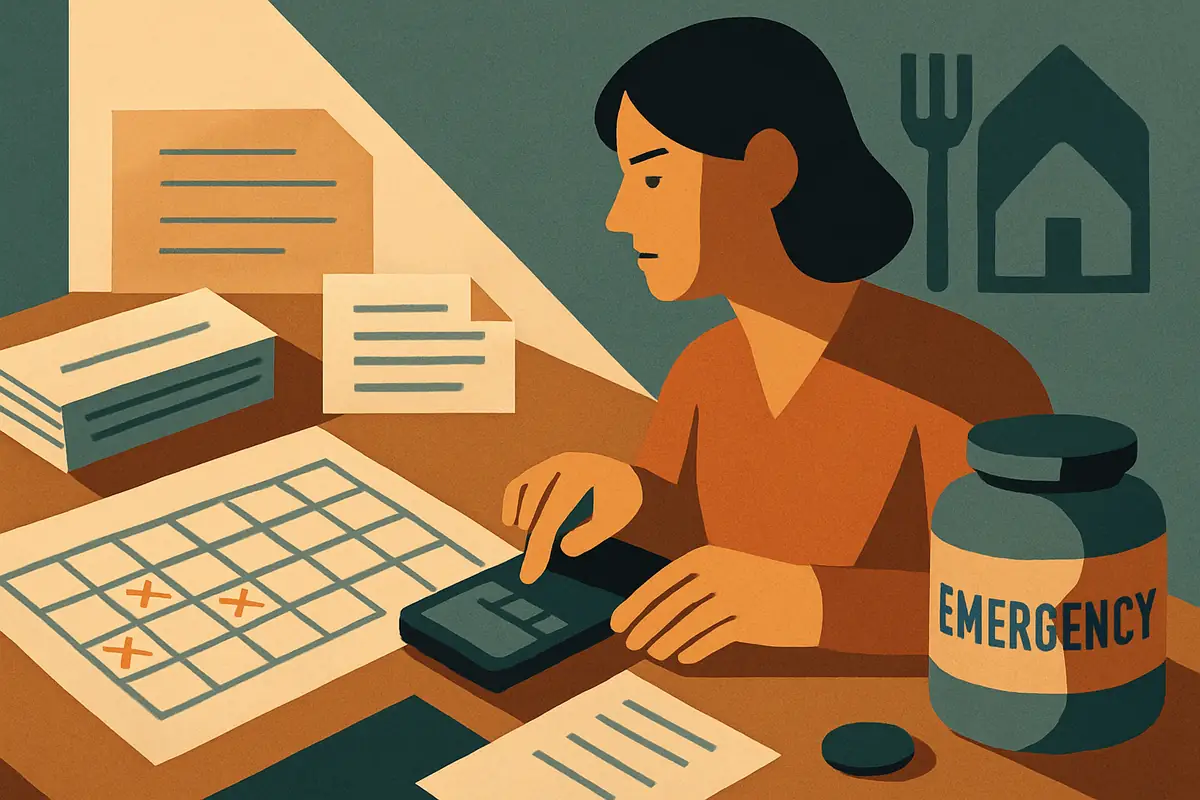
Each month, millions of Americans experience the stress of making sure their bills—ranging from $1,500 to $3,000 for essentials like rent, utilities, and groceries—clear before their next paycheck arrives. This isn’t just a matter of arithmetic; it’s a psychological balancing act between maintaining control over every dollar and allowing enough flexibility to adapt to life’s financial surprises. Cash flow planning operates at this intersection of numbers and emotions, shaping not only what you spend but how you feel about your money.
Cash Flow Planning Involves More Than Simple Math
While cash flow planning appears straightforward—add up all income sources, subtract expenses, and track what remains—psychological factors often complicate the process. Financial uncertainty, such as variable utility bills that can swing by $50 to $150 month to month, can trigger anxiety or avoidance. This might lead someone to delay paying a credit card bill (with annual percentage rates, or APRs, typically between 18% and 30%) out of fear of seeing their balance drop, or to ignore tracking small purchases like coffee runs that can add up to $50–$100 monthly. These emotional responses can create a cycle where practical plans are undermined by psychological resistance.
Timing adds another layer of complexity. Most people receive income on a biweekly or monthly schedule, but expenses occur daily or weekly. For example, if you’re paid on the 1st and 15th but your rent and utilities are due in the first week, you may experience a cash squeeze mid-month. This mismatched timing can result in last-minute borrowing—such as using overdraft protection, which often carries fees of $25 to $35 per incident—or skipping planned savings deposits just to cover immediate needs. According to typical surveys, 40% to 60% of households report feeling stress from these timing mismatches, regardless of income level.
Mental Models Shape Money Flow Decisions
The brain uses mental models—shortcuts for understanding complex realities—to simplify financial decisions. For instance, "all-or-nothing" thinking may lead you to believe that overspending by $30 on groceries ruins your entire monthly budget, even if your total grocery budget is $500. Loss aversion—the tendency to fear losses more than valuing equivalent gains—can cause people to hoard cash in checking accounts instead of paying down high-interest debt or investing, even when the opportunity cost is significant. Recognizing these patterns is key: if you hesitate to adjust your budget after an unexpected $200 car repair, it may feel like failure, but it’s actually a chance to learn and adapt. Knowing that these mental shortcuts are common can reduce guilt and help you approach cash flow planning with greater flexibility.
Scenario: Two Families Managing Irregular Income
How this can look in practice
Kim and Dana both manage household finances with irregular incomes—sometimes earning $2,000, other months $3,500. Kim uses strict spreadsheets, tracking every transaction down to the dollar and reviewing accounts daily. Dana sets broad categories with maximums (e.g., $400 for groceries, $150 for entertainment) and allows $200 monthly for unplanned expenses, reviewing spending weekly without monitoring every purchase.
Kim experiences relief from knowing exactly where money goes, but the process is time-consuming—often taking 30 to 60 minutes daily—and can cause anxiety when numbers fluctuate unexpectedly. Dana feels less day-to-day stress, spending about 30 minutes weekly reviewing finances, but sometimes loses track of discretionary spending, leading to $100–$200 in surprises at month-end. Both approaches highlight the trade-off between control and flexibility, with personal psychology influencing which style feels most sustainable.
Weighing Control Versus Flexibility in Cash Flow Planning
A "tight control" approach involves frequent updates, detailed tracking, and strict limits on spending. This can provide a sense of security by identifying problems early—such as catching a $50 recurring subscription you forgot to cancel—but may also lead to increased pressure or reduce enjoyment if the process feels too rigid. On the other hand, a "flexible" approach uses buffer funds (extra money set aside, often $100–$500) and less frequent reviews. This lowers daily stress and accommodates unexpected expenses, but can result in unnoticed overspending if buffers are treated as extra cash rather than safety nets. For example, if your buffer fund is $300 and you dip into it for a $120 car repair and a $90 dinner out, you’re left with only $90 for the rest of the month’s surprises.
| Approach | Benefits | Drawbacks |
|---|---|---|
| Tight Control | Clear insight into spending; early problem detection; can boost discipline | Time-consuming (30–60 minutes daily); can feel restrictive; may cause anxiety, especially if monthly cash flow varies by $500 or more |
| Flexibility | Less monitoring stress; easier to adapt; encourages forgiving mistakes | Risk of unnoticed overspending (up to $100–$200/month); less precision; potential end-of-month surprises |
Timing Shapes the Emotional Experience of Cash Flow
In personal finance, the timing of income and expenses is crucial. The emotional tone of your month can swing from relief when a $2,500 paycheck lands to dread when $1,200 in bills are due before your next deposit. Aligning bill payments with paydays can smooth this experience, but not all companies allow flexible due dates. Many people experience a "cash gap"—a period of low balances—of 3 to 7 days each month, which can prompt urgent decisions like transferring funds from savings or using credit cards with APRs of 18% to 30%.
Predictable timing reduces uncertainty. If you know your $800 rent and $200 utility bills are automatically withdrawn right after payday, you’re less likely to worry about missing payments. However, life rarely fits neatly into these patterns. Emergencies such as a $350 car repair or a delayed paycheck can disrupt even the most carefully timed plans. Surveys show that 60% to 75% of people report stress from mismatched income and expense timing, and about 35% delay bill payments at least once a year due to cash flow anxiety. Conversely, 65% to 75% say that using a flexible budgeting approach—such as maintaining a buffer fund or adjusting categories monthly—reduces their financial stress.
Mental Framing: How Language Influences Financial Habits
Mental framing refers to how you interpret and talk about financial situations internally. For example, viewing a $400 monthly food budget as a "restriction" may sap motivation, while seeing it as a "challenge" or an "investment in health" can boost adherence. Positive framing—focusing on what your budget enables, such as saving $100 a month for a vacation or paying down $2,000 in credit card debt—can soften feelings of deprivation. Negative framing, by contrast, can amplify feelings of scarcity or failure, making it harder to stick to plans after a setback like an unexpected $150 bill.
Recognizing Emotional Triggers in Cash Flow Management
Certain triggers—such as seeing an account balance drop below $200 or receiving an unexpected medical bill for $300—can spark strong emotional reactions that override logical decision-making. Awareness of these triggers allows you to pause before reacting impulsively, such as making a hasty $500 transfer from savings or charging a purchase to a credit card with a high APR. Developing this self-awareness can involve keeping a journal of spending-related emotions or discussing money feelings with a partner or trusted friend, which helps normalize these experiences and reduces shame.
Payment Timing
Try to schedule bill due dates within 3 days of payday to minimize periods of low balances and reduce reliance on overdraft or credit.
Buffer Funds
Maintain a separate buffer fund of $100–$500 to cover unexpected expenses and ease anxiety during cash gaps.
Review Frequency
Set a review schedule that fits your style: daily for detail-oriented tracking, or weekly/monthly for those who prefer flexibility. Most people spend 30–60 minutes weekly on this task.
Building Routines That Balance Psychology and Practical Needs
Establishing routines that fit your natural tendencies can make cash flow planning less mentally taxing while still maintaining financial control. For example, automating bill payments for fixed expenses (like $800 rent or $100 insurance premiums) and scheduling a manual review every week or month blends convenience with awareness. Some people start their day by checking spending against planned limits, while others reflect in the evening to identify needed adjustments—both are valid if they lead to consistent action.
| Calculation Example: Building a Buffer Fund |
|---|
| Suppose you want a $300 buffer fund for unexpected expenses. If you set aside $25 each payday (biweekly), you’ll reach your goal in 6 pay periods ($25 x 6 = $150 in 3 months; $25 x 12 = $300 in 6 months). This approach allows you to build a safety net gradually without straining your regular budget. |
When to Adjust Your Plan: Recognizing the Need for Flexibility
Rigid plans can break down when life changes unexpectedly—such as a $500 medical bill, a job change, or a family emergency. When budgeting starts to feel like punishment, or you frequently override planned categories (e.g., reallocating $100 from groceries to entertainment without updating your budget), it’s a sign to rethink your approach. Building slack into your budget—such as allowing a 10% buffer in each category—acknowledges human error and protects your core financial goals, like maintaining a $1,000 emergency fund or consistently saving $50 per month for retirement.
Balancing Action and Reflection in Daily Money Management
Cash flow planning is as much about emotional resilience as it is about numbers. Allowing for reflection—such as noting your stress level before checking your account balance or celebrating when you hit a $500 savings milestone—can reduce burnout and help maintain motivation. Pairing practical steps (like automating a $100 monthly transfer to savings) with moments of self-awareness builds deeper financial knowledge and confidence. Surveys indicate that 45% of people who recognize their emotional responses to spending report improved budgeting success, and 70% to 80% who combine automation with manual review feel more in control with less stress.
Emotional Triggers and Spending Habits
Emotional triggers—such as stress or the desire for a reward—can drive spending or saving behaviors. For example, retail therapy during stressful periods may lead to unplanned purchases totaling $100–$300 per month, undermining cash flow stability. Conversely, feelings of accomplishment can encourage intentional decisions, such as directing a $200 bonus toward savings instead of discretionary spending. Recognizing these patterns helps individuals anticipate and manage their reactions, strengthening overall cash flow management.
To mitigate emotional spending, set clear budgets linked to your values and goals. For significant purchases over $100, implement a 24-hour waiting period to allow emotions to settle and rational analysis to prevail. Keeping a spending journal can reveal patterns—such as increased spending after a stressful workweek—that inform future choices. Over time, this awareness supports better discipline and aligns decisions with long-term financial well-being.
The psychology of reward also plays a key role. Small rewards, like a $20 treat for hitting a monthly savings target, can reinforce positive habits. However, ignoring the need for occasional indulgences may lead to burnout and rebellion against strict plans. Balancing discipline with flexibility—such as allocating $50 per month for guilt-free spending—creates a sustainable approach to cash flow management.
Cognitive Biases Influence Cash Flow Decisions
Cognitive biases are systematic errors in thinking that affect financial decisions. Optimism bias, for example, leads people to overestimate future income or underestimate expenses, resulting in overly optimistic cash flow projections. This might mean planning for $500 in monthly savings when actual leftover cash is only $200, leading to shortfalls and potential debt. Recognizing this bias encourages more conservative estimates and contingency planning, such as maintaining a 10% buffer in your budget for unexpected costs.
Confirmation bias is the tendency to focus on information that supports existing beliefs while ignoring contradictory data. In cash flow planning, this can mean celebrating a $200 pay raise while overlooking rising expenses, such as a $50 increase in utility bills. Combatting this bias involves regularly reviewing all financial data and seeking input from trusted advisors or peers who can challenge assumptions.
Loss aversion—the tendency to feel losses more acutely than equivalent gains—may cause people to avoid selling underperforming investments or to hold onto high-fee accounts. For example, someone might keep a $1,000 balance in a checking account earning no interest rather than paying down a credit card with a 20% APR. Understanding loss aversion helps create plans that balance risk and encourage proactive money management.
Habit Formation Drives Financial Stability
Habits—automatic behaviors repeated over time—form the foundation of effective cash flow management. Positive money habits, such as setting up automatic bill payments (to avoid late fees of $25–$40), making regular $50–$100 contributions to savings, and conducting monthly budget reviews, reduce mental strain and the risk of errors. These routines, once established, support steady progress toward goals like building a $1,000 emergency fund or paying off a $2,000 credit card balance.
Negative habits, such as procrastinating on bill payments or consistently overspending by $100–$200 per month, erode stability and increase stress. Identifying triggers—like shopping online after a stressful day—allows for targeted interventions, such as setting spending limits or seeking accountability from a friend. Neuroscience research shows that repetition and reward are key: when saving $50 a month leads to a tangible benefit, like a vacation fund, the brain reinforces the behavior, making it more likely to stick.
Social Influences Affect Cash Flow Behavior
Social environments strongly shape attitudes toward money and cash flow planning. Peer pressure, cultural norms, and family upbringing influence whether you prioritize saving or spending. For example, living in a community where frequent dining out is common—costing $100–$300 monthly—can encourage higher discretionary spending, even if it strains your budget. Alternatively, participating in group savings challenges or financial workshops can foster disciplined habits and shared accountability.
Engaging with financially responsible peers, discussing progress with trusted friends, or joining communities focused on financial literacy can normalize prudent money behaviors. These social supports provide encouragement, practical advice, and motivation, making it easier to stick to cash flow plans even when facing common obstacles like unexpected expenses or income fluctuations.