Early financial mistakes are rarely dramatic. A $30 impulse buy, a $15 forgotten subscription, or a $50 late payment fee may seem minor. But repeated small missteps can add up: overspending by just $25 each week leads to $1,300 per year in lost savings. Over time, these patterns become much harder to reverse, especially as financial responsibilities grow.
The importance of personal finance education in young adulthood is rooted in habit formation. The first years of independent money management—often between ages 18 and 25—establish routines that, if left unchecked, can result in persistent debt or missed opportunities for growth.
Young adults who develop financial discipline early don't avoid all mistakes; they simply keep those mistakes small and manageable, allowing gradual improvement without long-term damage.
Financial Education Is Most Effective Before Incomes Grow
Many believe that detailed financial planning only matters once annual income exceeds $40,000 or more. In truth, the groundwork is often laid when monthly income is still between $800 and $2,500. The same habits that cause overdrafts or missed bills at this stage can lead to larger issues—like chronic debt or missed investment opportunities—when paychecks increase.
For example, failing to track a $200 monthly discretionary spending gap as a student can become a $600 gap once full-time work begins. The lesson: small budgets reveal the same structural weaknesses as large ones, just with less risk.
The most crucial early skills are basic:
- Identifying monthly obligations (like rent, utilities, and loan payments)
- Separating fixed costs (which stay the same, such as insurance) from flexible spending (which varies, like dining out)
- Recognizing delayed costs (such as annual fees or future repairs)
- Reading financial terms, such as APR (Annual Percentage Rate, the yearly cost of borrowing money, including fees and interest)
Building these abilities matters more initially than understanding investment vehicles or tax strategies.
Invisible Spending Is a Major Risk for Young Consumers
Today’s young adults face a financial landscape that is more digital and frictionless than ever. According to surveys, nearly 90% of people under 25 use mobile payment apps, and the average person in their early 20s has between 3 and 7 active digital subscriptions, each costing $5 to $20 monthly.
Spending now happens with almost no physical exchange of money:
- One-click purchases that take seconds
- Automatic renewals for streaming, cloud storage, or meal kits
- Buy-now-pay-later options, which split even $100 purchases into $25 installments
- Targeted social media ads encouraging instant buying
Because money leaves accounts invisibly, it’s easy to underestimate the true monthly impact. Ten $9.99 digital charges may seem insignificant individually, but together they total nearly $100—a sizable portion of a $1,000 budget.
A young person may not recall each $10 or $15 digital payment, but the sum can quietly reduce savings and increase the risk of overdraft or credit card utilization (the percentage of available credit being used, which can affect credit scores).
Impulse Buying Is Largely Shaped by Environment
Impulse purchases—often defined as unplanned purchases made without premeditation—are rarely random. Studies show that nearly 60% of young adults make at least one impulse buy per week, often triggered by environmental cues.
Common triggers include:
- Urgency messages like "Only 2 left at this price!"
- Limited-time discounts (such as flash sales or "today only" offers)
- Personalized advertising based on browsing habits
- Social proof, like seeing friends purchase the same item
With mobile devices, these triggers are nearly constant. Even strong self-control can be overcome by frequent, targeted prompts. That’s why relying solely on discipline is rarely enough—systems and routines are needed to create distance from spending decisions.
A practical tactic is the 24-hour rule: before making any non-essential purchase over a certain amount (for example, $50), wait a full day. This intentional delay often reduces regret and helps distinguish wants from needs.
Even a short pause can drastically change outcomes. For example, waiting 24 hours before buying a $120 pair of shoes may reveal that the purchase isn’t necessary, keeping that money available for future needs.
A First Budget Should Be Realistic and Flexible
Many first-time budgets fail because they aim for perfection or ignore the unpredictability of real life. In practice, monthly expenses can swing by $100 or more due to irregular costs like gifts, car repairs, or medical copays.
A functional first budget accepts this variability:
Weak First Budget
- Too rigid (no room for unplanned expenses)
- Ignores irregular costs (like annual subscriptions or seasonal spending)
- Fails after one unexpected bill
Functional First Budget
- Uses broad categories (such as housing, food, transportation, savings, and personal)
- Includes a buffer for "miscellaneous" costs (typically 5–10% of monthly income)
- Reviews and adjusts monthly to reflect actual spending
The goal is not to eliminate all mistakes, but to make spending visible. Once patterns are tracked, even small improvements—like reducing takeout from $60 to $40 per month—can have a lasting impact.
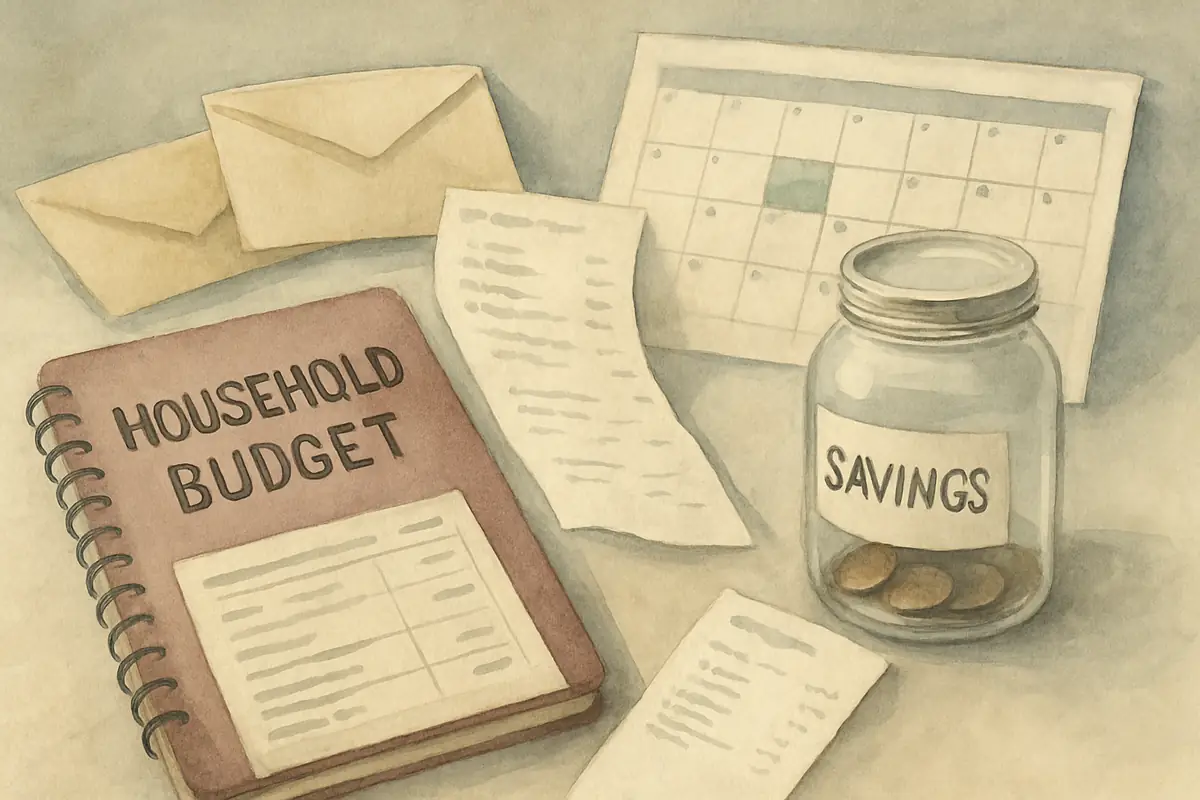
Worked Example: Suppose monthly income is $1,500. You allocate $600 for rent, $200 for groceries, $100 for transportation, $100 for subscriptions and entertainment, $75 for savings, and $75 for a miscellaneous buffer. After tracking expenses for three months, you notice that subscriptions average $140, not $100, and groceries sometimes reach $250. You adjust your budget: reduce entertainment to $80, limit subscriptions to $120, and increase groceries to $225. This process of review and correction is key to building a sustainable budget.
Emergency Savings Are Essential, Even With Modest Means
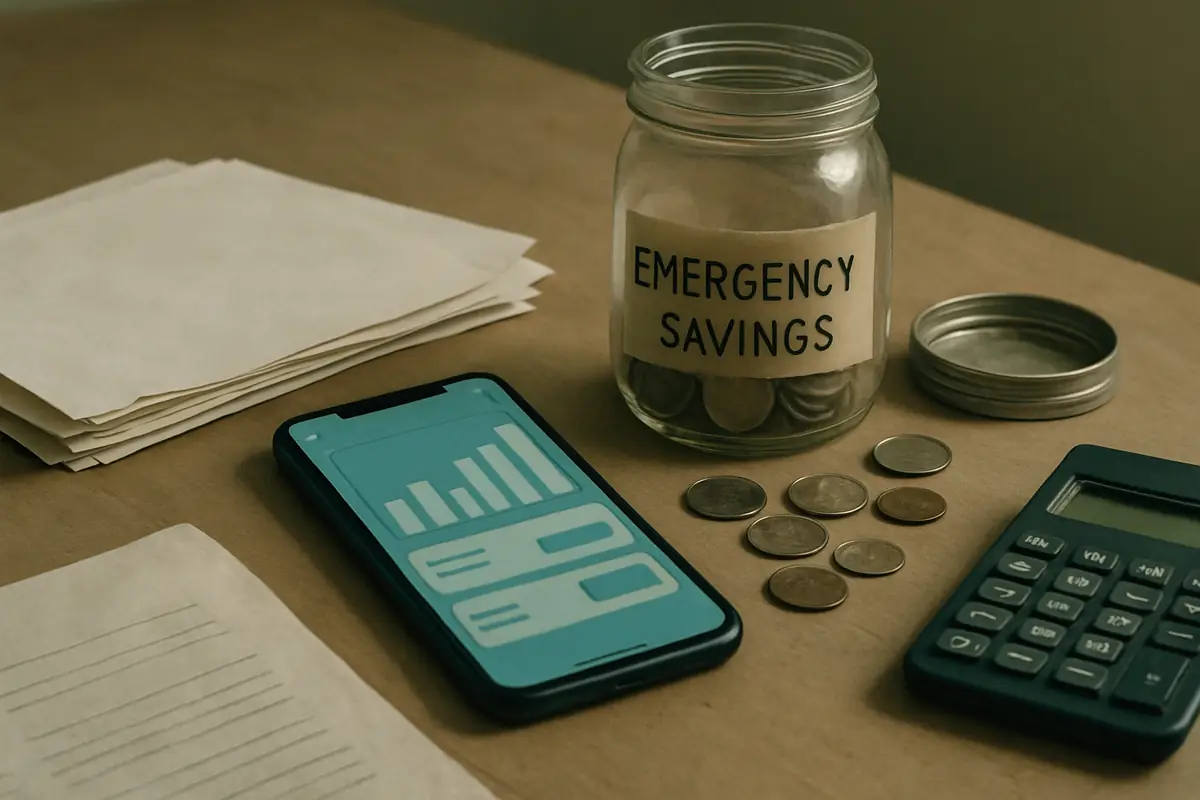
It’s common for young adults to delay building emergency savings, feeling that small amounts—like $100 or $200—won’t make a difference. But even a modest reserve can prevent minor setbacks from spiraling into debt.
For example, a $150 car repair or a $75 medical copay can quickly become credit card debt if no cash buffer exists. Without an emergency fund, these events often lead to balances on credit cards, which commonly carry APRs (Annual Percentage Rates) between 18% and 30%. This means a $200 emergency, if left unpaid for a year at 24% APR, could accrue nearly $50 in interest.
- Unexpected transportation costs (like a $40 taxi after a car breakdown)
- Urgent repairs (such as a $90 phone screen replacement)
- Short-term income gaps (like waiting for a first paycheck)
- Medical needs, from $20 copays to $200 urgent care visits
Even a $250 emergency fund can cover many of these events, avoiding reliance on high-interest credit.
Credit Is a Tool, Not Free Money
Credit cards and digital financing options can make it feel like you have extra money, but credit is not income—it’s the ability to borrow against future income, often with significant costs. Credit card APRs frequently range from 18% to 30%, and missing a payment can add late fees of $25 to $40.
Understanding this distinction early is crucial. For example, carrying a $500 balance at 24% APR and making only minimum payments can result in over $100 in interest charges over a year. Credit utilization—the percentage of available credit used—should ideally stay below 30% to avoid damaging your credit score.
Learning to see credit as a tool for building a positive payment history, rather than as available cash, helps avoid cycles of unnecessary debt.
Start Investing Early, Even With Small Amounts
Many young adults believe investing requires thousands of dollars. In reality, starting with as little as $25 per month can be valuable. The main advantage is time, not size: investments have more years to benefit from compounding, where returns earn additional returns over time.
For example, investing $50 per month from age 22 to 32 (10 years) at an average annual return of 7% can grow to over $8,600. Waiting just five years to start reduces this to about $5,600—a difference of $3,000, simply due to compounding.
Early investing also builds key skills:
- Patience through market ups and downs
- Understanding risk (the chance of losing money in the short term)
- Recognizing expense ratios (the annual fees charged by investment funds, usually between 0.05% and 1%) and how they affect returns
The educational value of starting small—learning how markets work, how to automate contributions, and how to avoid emotional decisions—often outweighs the immediate dollar gains.
Financial Confidence Grows Through Routine Practice
Many young adults wait until they "feel ready" to take control of their finances. In reality, confidence is built through repetition, not motivation. Simple habits—like tracking spending weekly, saving automatically (even $10 per paycheck), reviewing account statements, and correcting small mistakes—gradually reduce anxiety.
- Regular spending reviews (monthly or biweekly)
- Automatic transfers to savings, even in small amounts
- Checking credit card statements for errors or fraud
- Addressing overdrafts or late payments immediately
Over time, these routines replace uncertainty with knowledge. Even after a setback, returning to these habits quickly is more important than perfection.
Learning Early Reduces the Cost of Inexperience Later
As financial responsibilities increase—such as renting an apartment (which can require deposits of $500 to $2,000), supporting a family, managing student loans, or planning for retirement—the stakes become much higher. Poor early habits can lead to higher borrowing costs, denied applications, or missed opportunities for growth.
- Housing decisions (renting vs. buying, with mortgages often requiring 3% to 20% down)
- Family obligations (childcare, which can cost $200 to $1,000 per month)
- Long-term debt (student loans, car loans, or mortgages)
- Retirement planning (starting in your 20s can double the end result compared to waiting until your 30s)
Those who understand financial mechanics—like amortization (the gradual repayment of debt over time), compound interest, and the impact of fees—before reaching these stages are better equipped to make calm, informed decisions.
Starting early does not just improve current financial control; it reduces the future cost of inexperience. Financial adulthood begins quietly, often before significant wealth is built. The advantage gained by learning early can compound, both financially and in confidence, for decades to come.
References
- https://www.mymoney.gov/
- https://www.fdic.gov/resources/consumers/
- https://www.fdic.gov/resources/consumers/money-smart/
- https://www.consumerfinance.gov/consumer-tools/educator-tools/your-money-your-goals/
- https://www.federalreserve.gov/consumerscommunities/shed.htm
- https://www.consumerfinance.gov/consumer-tools/