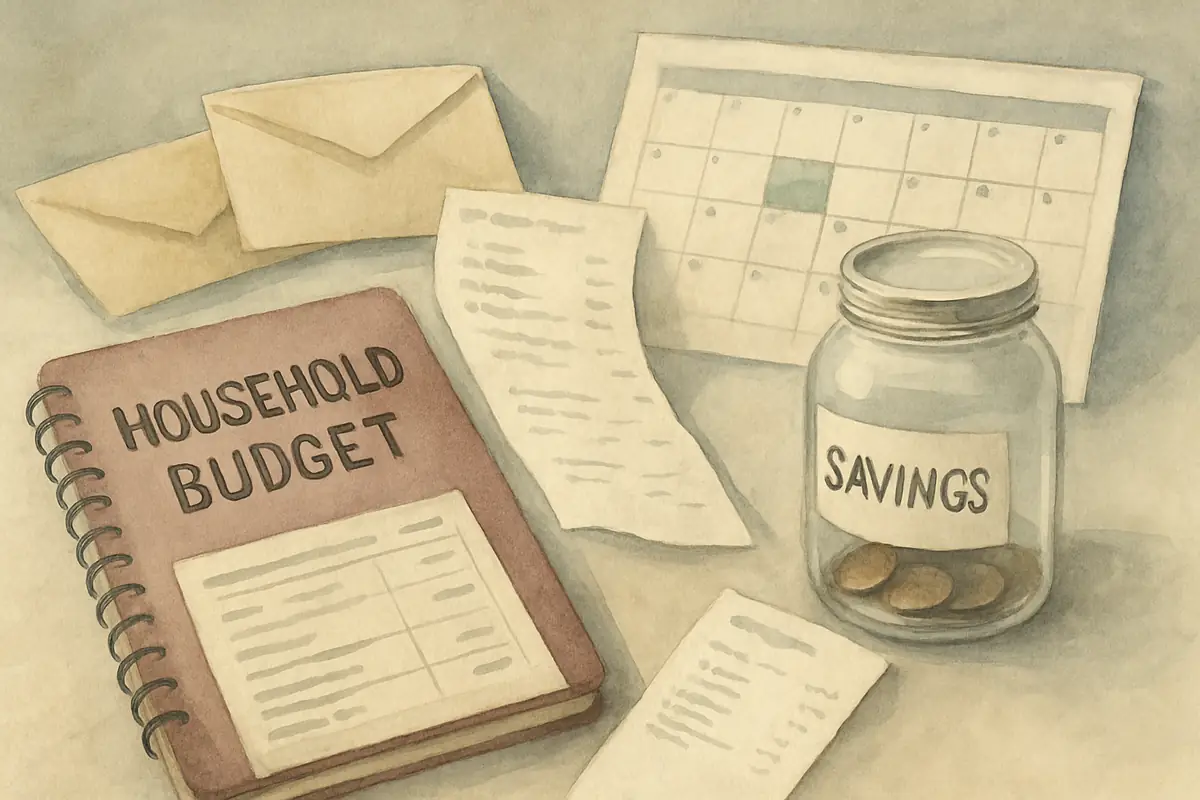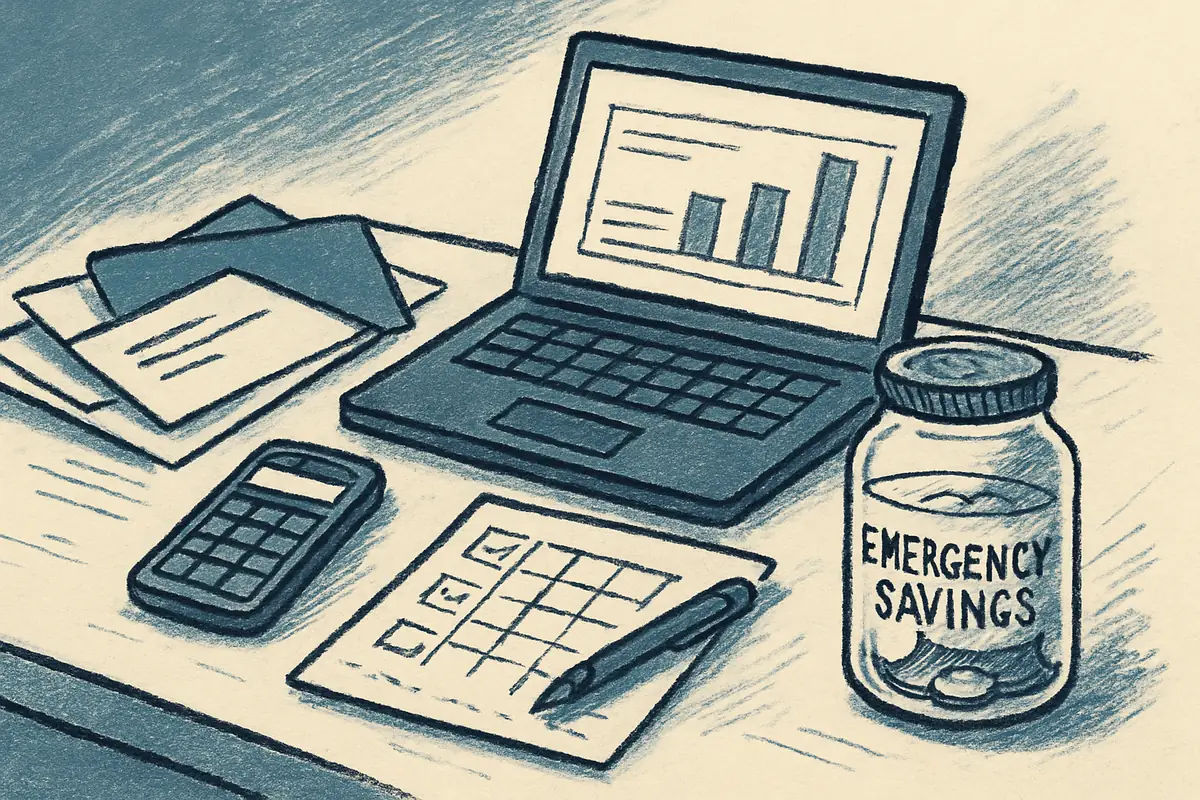
On a rainy Tuesday evening, the Thompsons sit at their kitchen table surrounded by bills, a half-full grocery bag, and a laptop opened to their budgeting app. They are trying to stretch their $4,200 monthly household income across $1,500 rent, $250 utilities, $400 in credit card payments (with credit card annual percentage rates, or APRs, typically ranging from 18% to 30%), and their two kids’ activities—all while wondering if they can safely add even $50 more to savings this month. This quiet moment is a familiar reality for millions of households: everyday financial choices quietly carry risks that shape long-term stability in ways that aren’t always obvious.
Everyday Financial Management Decisions Carry Hidden Risks
Financial management is more than tracking numbers—it’s about timing, trade-offs, and coping with uncertainty. Most households juggle fixed expenses like rent or mortgage, which often account for 25% to 40% of take-home pay, alongside irregular costs such as car repairs or medical bills. Income streams can fluctuate due to overtime, seasonal work, or gig jobs, while inflation—averaging 3% to 8% in recent years—slowly erodes purchasing power. Each choice to pay down debt faster, save more aggressively, or cut back on spending brings potential consequences that may not be immediately visible. These quiet risks can chip away at stability or flexibility over months or years without clear warning signals.
For example, reducing discretionary spending by $200 per month might boost savings by $2,400 in a year, but could also limit social connections or family activities. On the flip side, prioritizing lifestyle today can leave emergency funds thin, increasing reliance on high-interest debt if an unexpected $1,000 car repair arises. Even the best-planned budgets are vulnerable to surprise medical bills—often ranging from $500 to $2,500—or sudden income dips, making every decision a balance of nuanced risks.
Balancing Safety and Flexibility in Household Budgets
At the heart of financial decision-making is the tension between security and adaptability. Directing extra cash flow toward debt repayment can reduce long-term interest costs—especially if credit card APRs are above 20%—but may strain monthly budgets and leave less for emergencies. Holding more liquid savings (easily accessible cash) offers peace of mind, but slows progress on reducing debts that often accrue $50 to $150 in interest each month for average balances.
Families often ask: Should we prioritize paying off credit cards or keep higher cash reserves? The answer depends on risk tolerance and life circumstances. For households with irregular income or unstable jobs, maintaining three to six months’ worth of expenses in savings—typically $6,000 to $12,000 for many families—might be crucial, even if it means slower debt payoff. Those with reliable paychecks may choose to pay down debts faster, knowing they can rebuild savings if needed.
Where Prioritizing Savings Helps
- Provides a buffer against unexpected expenses like $700 medical bills or $1,200 car repairs.
- Reduces stress by building financial confidence over time.
- Maintains greater flexibility when income fluctuates by 10% to 30% month to month.
Where Caution is Needed When Prioritizing Savings
- May delay paying down high-interest debts, increasing long-term costs by hundreds or thousands of dollars.
- Can tempt overspending if buffers feel too comfortable.
- Might limit funds available for investing in career or education opportunities, which often require upfront costs of $500 to $5,000.
Income Stability Is a Key Driver of Household Financial Risk
Income variability is often underestimated when assessing household financial risk. Even families with steady jobs can experience hours cuts, delayed paychecks, or seasonal slowdowns. For those relying on bonuses, commissions, or gig economy work, income can swing by 20% or more in a typical year. Without accounting for these realities, budgeting decisions may appear safer on paper than they are in practice.
For instance, the Thompsons’ income dipped by $600 one winter when contract work slowed. Their budget, which had assumed steady inflows, did not account for this risk. As a result, they had to rely on credit cards, adding $400 in new balances at 22% APR—costing them nearly $90 in extra interest over six months if not paid off quickly. This unexpected expense increased their risk exposure, even though they had previously built up $1,200 in savings.
Where readers should be careful
"Ignoring income variability can lead to overestimating your financial cushion. Planning for stable inflows only leaves fragile gaps uncovered."
Timing Monthly Expenses Presents Subtle Risks
"Paying bills early" or "stretching payments" are common strategies to manage cash flow. Yet timing matters: paying a $300 utility bill early in the month might strain liquidity when a $500 rent payment is due at month’s end. Conversely, delaying payments to maintain flexibility can risk late fees—often $25 to $40 per missed deadline—or even lower your credit score if payments are more than 30 days late. Credit utilization, or the percentage of available credit used, also plays a role: high utilization above 30% can negatively impact credit scores.
"Timing decisions around monthly expenses feel straightforward but hide quiet risks," says Olivia Hayes, a household finance expert. "The interplay between bill due dates and actual paychecks requires constant attention because delays or surprises in either direction ripple through other financial commitments."
Determining an Appropriate Emergency Fund Size
The term "emergency fund" refers to a cash reserve set aside for unexpected expenses, such as job loss or urgent repairs. Conventional advice suggests saving three to six months of living expenses—often $6,000 to $18,000 for a typical family. However, for many, reaching this target can require cutting $200 to $400 per month from current spending, which may not be sustainable without sacrificing essentials or well-being.
Consider this worked calculation example: If the Thompsons’ essential monthly costs (rent $1,500, utilities $250, groceries $600, transportation $300) total $2,650, building a three-month emergency fund would require $7,950. Saving $250 per month, it would take them nearly 32 months to reach this goal. Starting with a $1,000 emergency fund, as they did, covered minor emergencies but left them exposed to larger shocks. Many households must find their own balance point between adequate coverage and maintaining a reasonable quality of life.
Assess Regular Expenses
Calculate essential monthly costs, including rent or mortgage (typically 25%–35% of income), utilities, groceries, and transportation.
Factor in Irregular Costs
Include periodic expenses like $400 car maintenance or $150 annual medical checkups.
Define Income Stability
Consider whether paychecks are predictable or fluctuate by season or commission—volatility of 10%–30% is common in some sectors.
Debt Paydown and Savings: Managing the Ongoing Trade-Off
"Pay down debt fast" versus "build savings first" is a common debate, but the reality is more complex. Credit card interest rates (APRs) commonly fall between 18% and 30%, making debt expensive to carry. However, having liquid savings—even $1,000 to $2,000—can prevent the need to borrow at high rates in an emergency. Utilization ratio, which measures the amount of credit used compared to total available credit, also affects credit scores; keeping utilization below 30% is generally recommended for a healthy score.
Choosing Faster Debt Payoff Benefits
- Reduces cumulative interest paid—paying off a $5,000 balance at 24% APR saves over $1,200 in interest over two years compared to making only minimum payments.
- Improves credit profile by lowering utilization ratios (the percentage of credit used versus available credit).
- Frees up future cash flow by eliminating monthly payments, often $200 to $400 per card.
Risks When Debt Payoff Outpaces Savings Growth
- Leaves households vulnerable if emergencies arise and no liquid savings are available.
- Forces reliance on new borrowing at high rates under stress.
- May require harsh spending cuts, impacting essentials or well-being.
Many households compromise by maintaining a modest emergency fund—often $1,000 to $3,000—while steadily increasing debt payments, balancing short-term safety with long-term cost reduction instead of pursuing extremes.
Inflation Quietly Pressures Household Budgets Over Time
Inflation erodes purchasing power, with food prices rising by 4% to 6% annually in recent years and utilities increasing by 3% to 8%. Wage growth often lags behind, causing households to trim discretionary spending—such as entertainment or dining out—before cutting essentials. For example, a $600 monthly grocery budget may increase to $640 within a year due to inflation, requiring adjustments elsewhere.
Practical inflation planning means revisiting budgets every 6 to 12 months, adjusting savings targets, and prioritizing flexible spending categories. This approach protects core needs—like housing and healthcare—while maintaining resilience without unnecessary sacrifice.
A Day in Their Life: The Thompsons’ Ongoing Balancing Act
The Thompsons’ month begins with optimism as paychecks land, but a $1,200 car repair mid-month complicates plans. They delay $150 in discretionary spending on dining out and pause $100 in vacation fund contributions, while making minimum $400 credit card payments and covering regular bills. By mapping out expenses using envelopes labeled by due date and tracking inflows daily, they avoid overdraft fees—often $30 to $35 per incident—despite tight cash flow days. They accept that progress on emergency savings slows this month but gain confidence from maintaining control, avoiding late fees, and preventing new high-interest debt.
Recognizing Quiet Risks Changes Our Perspective on Money Decisions
Acknowledging these subtle risks encourages empathy for the imperfect trade-offs families make daily—between safety nets and present needs, control and flexibility. It shifts the focus from blame or rigid formulas to a nuanced understanding that personal finance operates in gray zones where context and adaptability matter most.
Rather than chasing flawless budgeting or strict goals, gradual progress amid uncertainty helps households build resilience over time, respecting current realities instead of denying them. Even small, consistent steps—like increasing savings by $20 per week or reducing debt by $50 per month—can add up to meaningful improvements within a year.
Returning to Everyday Realities with New Awareness
Back at their kitchen table weeks later, the Thompsons review recent bumps alongside small wins—a reminder that financial management is not a static plan but an evolving story shaped by unpredictable events and deliberate choices. They have accepted imperfections in budgeting as part of family life—not failures—and find peace knowing that their careful attention to timing payments and balancing priorities reduces unseen risks that might otherwise accumulate over time.
Psychological and Systemic Biases Shape Financial Decisions
Financial decisions are rarely made in a vacuum of pure logic. Unseen psychological biases—such as confirmation bias (favoring information that supports existing beliefs), loss aversion (fearing losses more than valuing equivalent gains), and familiarity bias (overinvesting in what is known, like an employer’s stock)—can subtly influence outcomes and distort risk assessment. For example, loss aversion may cause individuals to sell investments prematurely during a market downturn, missing out on potential recovery. These biases can quietly erode financial performance by clouding judgment, making it essential to develop awareness and strategies to mitigate cognitive blind spots.
Familiarity bias can lead decision-makers to concentrate investments in local ventures or a single company, increasing risk if that sector underperforms. Diversification—spreading investments across different asset types—can reduce this risk. Structured decision frameworks and seeking external perspectives can help counteract innate tendencies and lead to more balanced choices.
Beyond individual psychology, organizational culture introduces additional quiet risks. Companies that discourage dissent or critical questions may experience groupthink, where teams collectively endorse flawed plans without adequate scrutiny. When incentives focus on short-term gains—such as quarterly earnings targets—over long-term stability, decision-makers may prioritize immediate results at the expense of sustainable growth. Recognizing these cultural dynamics enables leaders to foster open dialogue and align incentives with balanced risk-taking behaviors.
Rapid technological change adds another layer of quiet risk. Technologies such as algorithmic trading and artificial intelligence have transformed finance but also introduced complexity and opacity. Overreliance on automated systems without sufficient human oversight can mask errors or systemic vulnerabilities until they result in significant losses. For example, a trading algorithm might execute thousands of transactions per second, but a single coding error can lead to outsized losses before detection. Staying attuned to technological trends and incorporating adaptive risk management practices helps organizations remain resilient amid evolving financial landscapes.
Environmental and regulatory uncertainties further compound quiet risks. Climate change poses both physical risks—such as property damage from extreme weather, which can cost thousands of dollars per event—and transitional risks related to shifting policies or market preferences. Regulatory frameworks can change with little warning, impacting taxation, compliance costs, or permissible activities. Failing to anticipate or adapt to these changes can erode competitive positioning and profitability. Scenario planning, which involves preparing for a range of possible futures, enhances resilience against these less visible but impactful risks.
Global market interconnectivity means that isolated events can cascade through portfolios and supply chains. Geopolitical tensions or localized economic crises can ripple outward, challenging risk assessments based on historical patterns. For instance, a 5% currency swing can quickly impact import costs or investment returns. Dynamic modeling tools, combined with qualitative insights, help prepare for sudden shocks that standard metrics might overlook.
To address these multifaceted quiet risks, comprehensive stress testing is vital. Stress testing simulates adverse conditions—such as sharp economic downturns or regulatory shifts—to observe potential impacts on portfolios or finances. This process can reveal vulnerabilities that routine analyses might miss. For example, testing how a 10% income drop or a doubling of utility costs would affect a household or firm can inform contingency planning. When stress tests reveal critical exposures, adjustments such as increasing capital buffers or strategic hedging can be implemented proactively, reducing the likelihood of severe losses.