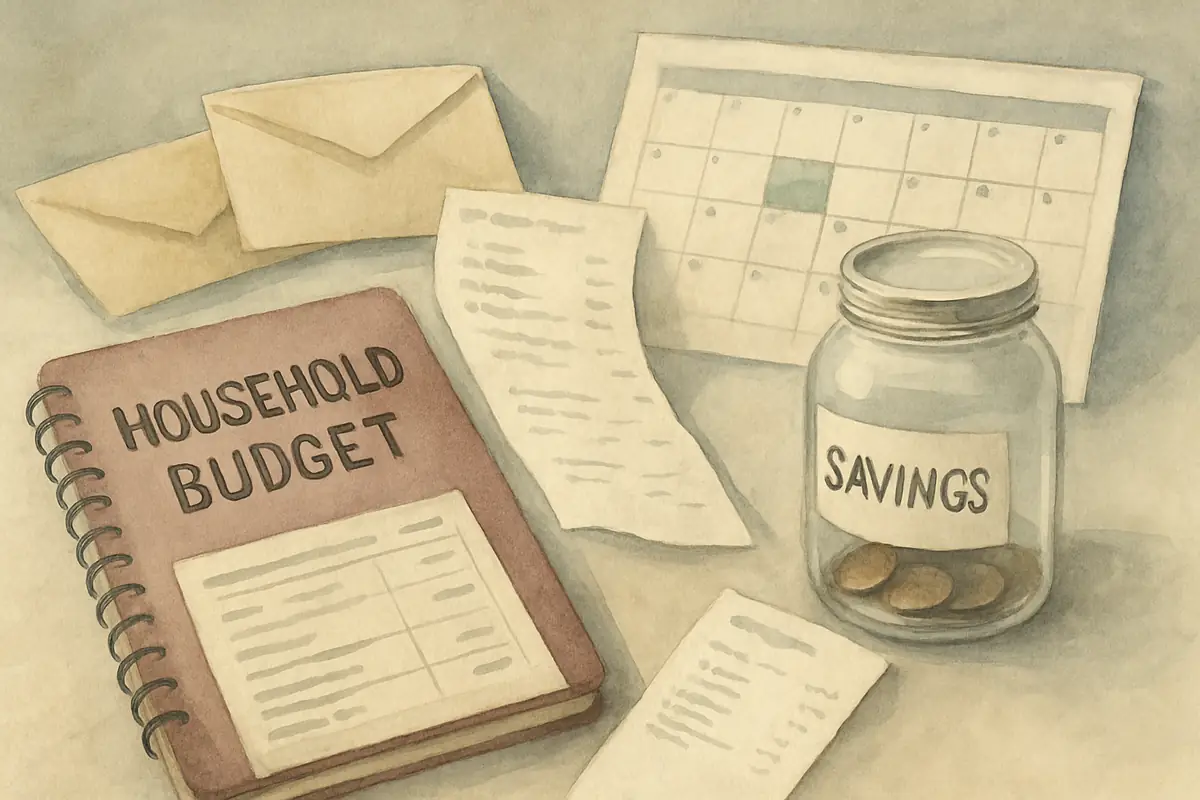
Roughly 4 in 10 American adults say they couldn't cover a surprise $400 expense from cash or savings — they'd have to borrow, sell something, or let a bill slide. If that sounds like your month, a budget stops being a spreadsheet exercise and becomes the difference between guessing and knowing on the day rent is due.
Picture a Tuesday evening after work: an envelope of receipts on the kitchen table, two overdue notices underneath, a checking balance that has slid from $840 to $312 in nine days. Worry, frustration, maybe a little denial.
In moments like this, a budget can feel like an added weight or a lifeline. Which one it becomes depends on approach: budgeting under stress isn't about penny-pinching or rigid rules, but about changing your relationship with money at the moment it feels most fragile.
Why budgets feel overwhelming when finances are tight
Budgets aren't always fun. Under pressure, listing expenses shines a light on uncomfortable truths — spending has outpaced income for four straight months, or savings would cover barely a week of bills instead of the emergency-fund benchmark of 3 to 6 months of essentials (6 to 9 if income is variable).
The numbers around you don't help. Even with inflation — the general rise in prices — running a calmer 2.5% to 3.5% a year lately versus its peak near 9% in mid-2022, the price level never went back down: groceries that cost $110 a week in 2021 can easily run $140 now. One slip below zero in checking triggers a $25 to $35 overdraft fee at many banks. Seeing it all written down sparks doubt — can I really control this? — and many people scrap the effort because the first draft feels discouraging.
Human routines and imperfect data
Then there's the reality of daily tracking. Grocery runs don't line up with pay periods. Utility bills swing — $90 in a mild October, $210 in a cold January. A budget built on exact numbers projected six weeks out quickly feels disconnected from lived experience.
Often, people pause their budgets over these small breakdowns instead of adjusting for the curveballs — one missed logging day becomes a reason to quit rather than to pick the pencil back up tomorrow.
What a useful budget looks like when rigidity backfires
A helpful budget in a rough stretch isn't perfect; it's workable and human enough to be a real guide, not an ideal to fall short of.
Instead of locking every dollar in place weeks ahead, it patches together short windows with flexible checkpoints — this week's non-negotiable bills covered, the rest scanned in broad brushstrokes rather than to the penny.
Building trust over control
When money stress is high, the goal shifts from forcing tight control toward rebuilding trust in yourself around finances.
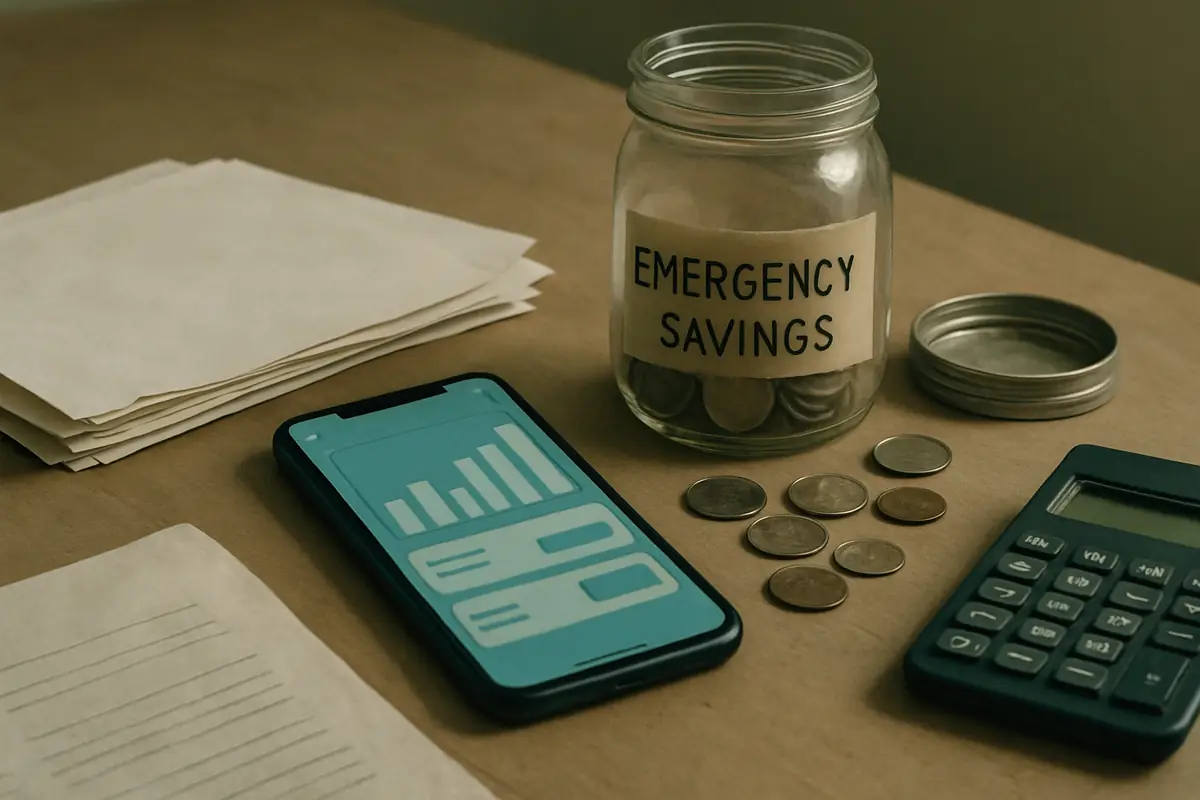
You reclaim confidence by locating the pinch points without judgment — just curiosity. What's due next? How much breathing room is left? Small wins compound: even $20 a week into a high-yield savings account — an online account paying around 3.5% to 4.5% APY, versus under 0.5% at many big banks — builds proof that you can steer. With deposit insurance covering up to $250,000 per depositor, per insured bank, that cushion is one place where nothing unexpected can happen.
How this can look in practice
Maria lost about $900 of freelance income to a two-week illness right before her $1,150 rent came due. One slow morning she wrote out only the essentials due in the next 10 days: rent, a $95 electric bill, roughly $180 for groceries — about $1,425 against the $980 in her account. Holding two numbers instead of a vague sense of doom cut the panic enough that she called her landlord that afternoon and arranged a split payment before any late fee hit.
How shifting priorities shape a budget under pressure
Stress pulls attention toward smaller windows — bridging today to the next paycheck feels more real than a full-month projection.
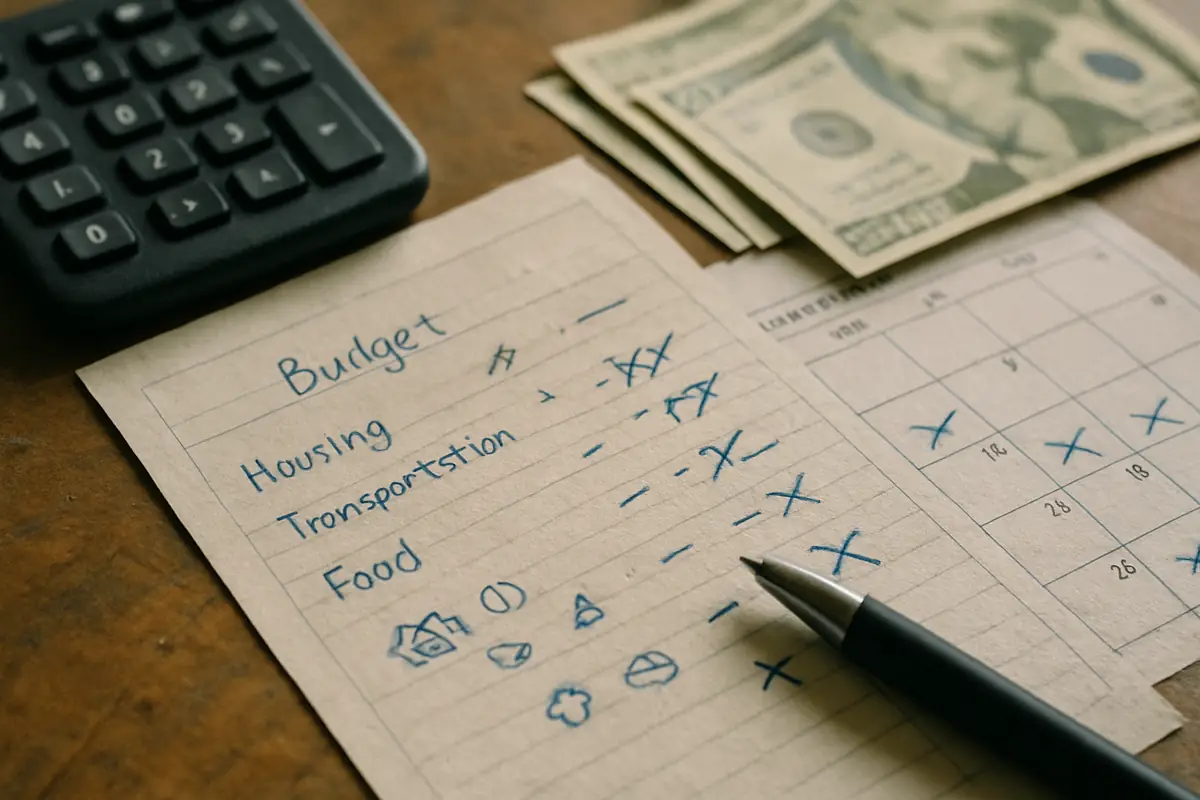
That upends typical budgeting advice, which centers on long-term goals. Survival budgeting means smoothing immediate gaps first: rent, food basics, utilities, the commute — before anything discretionary. It also means honesty about structural problems: housing is commonly benchmarked at 28% to 30% of gross income, and if rent alone eats 45% of take-home pay, trimming small purchases won't close that gap — the real conversation becomes income, housing, or both.
Here's a two-week survival check, step by step:
- Step 1 — Money in: your paycheck lands Friday at $1,700 after taxes.
- Step 2 — Essentials due within 14 days: rent share $1,150, electricity $130, groceries $280 (about $20 a day), gas and transit $120, phone $60. Total: $1,740.
- Step 3 — The gap: $1,700 minus $1,740 leaves you $40 short. Small — but hitting it as an overdraft adds a $25 to $35 fee, turning a $40 problem into a $65 to $75 one.
- Step 4 — Close it: push the $60 phone bill's due date back one week (most carriers allow this online), and the window ends $20 ahead instead of $40 behind.
Once essentials are secure, the lens widens — first toward catching up, then toward a $400 to $500 starter buffer for the next surprise.
Where readers should be careful
A survival-only focus can quietly deepen debt if credit card balances get ignored. Card interest typically runs 18% to 30% APR, and minimum payments are usually just 1% to 3% of the balance — enough to keep the account current, not to retire the debt, so minimum-only paydowns can stretch past a decade. Missing a payment costs a $30 to $41 late fee and dents your credit score, since payment history drives roughly 35% of common scoring models. Even in crisis mode, on-time minimums deserve a line in the plan.
Negotiating grace periods versus cutting costs
An overlooked lever is negotiating what's owed, not just tracking it. Utilities, lenders, and landlords frequently offer hardship plans, due-date changes, or fee waivers — but usually only to people who call before the account is delinquent. Card issuers already give a 21-to-25-day grace period between statement and due date; a proactive call can sometimes add a deferral on top. Asking early beats paying stacked fees later.
The role of expectations when setting up a budget in hard times
The toughest part may be forgiving yourself for stumbling during the attempt.
Budgets shift meaning when viewed less as perfection projects and more as ongoing conversations between where you are financially and where you're gradually trying to be.
- Olivia Hayes
That mindset reframes mistakes as signals — what to adjust next, not reasons to quit:
- Skipped logging a grocery trip? Enter a rounded estimate later — a $60 guess beats a blank line that derails the record.
- Bills ran $80 higher than planned? Build that into next month's buffer rather than punishing this month's numbers.
- Took out a payday loan? Track the repayment date obsessively — these commonly work out to 300% to 400% APR once fees are annualized, versus 7% to 36% on a typical personal loan — and seek help early if one loan starts rolling into the next.
Mix empathy with accuracy
The cycle between financial stress and smoother budgeting won't resolve quickly. But pairing accuracy about income and expenses with kindness toward your own mental load keeps the effort sustainable — and lets any method, app or paper notebook, survive the rough stretches as a supportive chapter in your money story rather than a punchline. Some weeks will look jagged; others, clearer.
Simplifying your budget makes it feel less daunting
Simplification doesn't mean giving up detail — it means narrowing focus to the few measurements that reflect current reality well enough to act on.
The hard part isn't inventing elaborate categories; it's committing to one modest routine. A 15-minute weekly session — due dates, balances, a rough estimate of everyday spending — beats the guesswork lurking between paychecks. Frameworks help as scaffolding: the 50/30/20 rule suggests roughly 50% of take-home pay for needs, 30% for wants, 20% for savings and debt. In a tight season your real split might be 70/20/10, and that's fine — the point is knowing your split, not matching a textbook. When you're mentally worn out, daily micro-tracking burns motivation fast; short weekly scans give the same early warnings for a fraction of the effort. If your income swings, at minimum write down the floor — the essential bills that never change. That list keeps a bad month from feeling bottomless, and it's the seed of the eventual 3-to-6-month cushion.
What to remember
- A budget in stressful times works best when it's flexible about conditions but firm about essentials — rent, utilities, food, minimum debt payments never fall out of sight.
- Gaps in logging or timing mismatches aren't failure; they're an invitation to use rounder numbers and gentler routines that survive real life.
- Narrow goals — covering the next 10 to 14 days — build momentum, then widen toward a $400 to $500 starter buffer once survival is secure.
- Fees are where tight budgets bleed: $25 to $35 overdrafts, $30 to $41 late fees, 300%-to-400%-APR payday loans — negotiate early and pay minimums on time.
- Whether hard-times budgeting feels like a breathless chore or an anchor comes down to trust — in the numbers you keep and your ability to adjust them.
How will you revisit your own budgeting assumptions now?
Stand back for a moment and consider:
- Am I expecting my budget to be perfect immediately, even though my income and expenses genuinely fluctuate?
- Where could a short weekly ritual keep me tuned in to critical needs without harsh self-judgment?
- When I miss a few days of tracking, how will I course-correct instead of abandoning the effort?
- Which essential payments need my focus first, before longer-term goals like rebuilding savings?
- What would treating myself with the patience I'd offer a friend change about how I restart?
A broken budget isn't a failed effort — it reveals the places that need a more forgiving design. Small adjustments feed resilience, and resilience compounds the way interest does: slowly, then noticeably. An incomplete ledger still maps a path through dense woods — far better than no map at all, wherever your finances stand today.