Most borrowers sign loan agreements expecting repayment schedules to be clear, predictable, and stable. Yet beneath the surface, these plans often contain variable elements that can significantly impact long-term costs and financial pressure. This article explores the real mechanics behind modern repayment schedules, clarifies common misconceptions, and details the evolving implications for consumers facing increasingly complex loan contracts.
Assumptions About Repayment Schedules Often Mask Hidden Complexities
Many borrowers believe repayment schedules are always fixed and straightforward, with monthly payments that fit comfortably into household budgets. The expectation is that if a loan advertises a $300 monthly payment over 36 months, that figure will remain unchanged. However, in reality, loan terms can shift due to adjustable interest rates, fees triggered by late or missed payments, or lender-initiated changes in response to market conditions. For example, adjustable-rate mortgages (ARMs) may start with a fixed rate for 3–7 years, then reset annually, potentially increasing monthly payments by hundreds of dollars depending on market rates.
Ancillary costs often go unnoticed: some personal loans advertise competitive rates but exclude administrative fees of $25–$50 per month, or origination fees ranging from 1% to 6% of the loan amount. Over a 5-year term, these added costs can increase total repayment by $1,000 or more on a $10,000 loan. Borrowers may also assume repayment periods are locked in, yet many contracts allow lenders to alter terms if the borrower misses payments or if broader economic conditions change. Early repayment penalties—often 1%–2% of the outstanding balance—can also catch borrowers off guard, making refinancing or paying off a loan early less attractive.
Where readers should be careful
Warning: Failing to scrutinize details such as annual percentage rate (APR, the yearly cost of borrowing including fees and interest), collateral requirements, or penalty clauses can expose borrowers to substantial, unexpected financial burdens. Even a $15 recurring fee, if overlooked, adds $180 per year to the cost of a loan.
Interest Rates and Fee Structures Directly Shape Repayment Outcomes
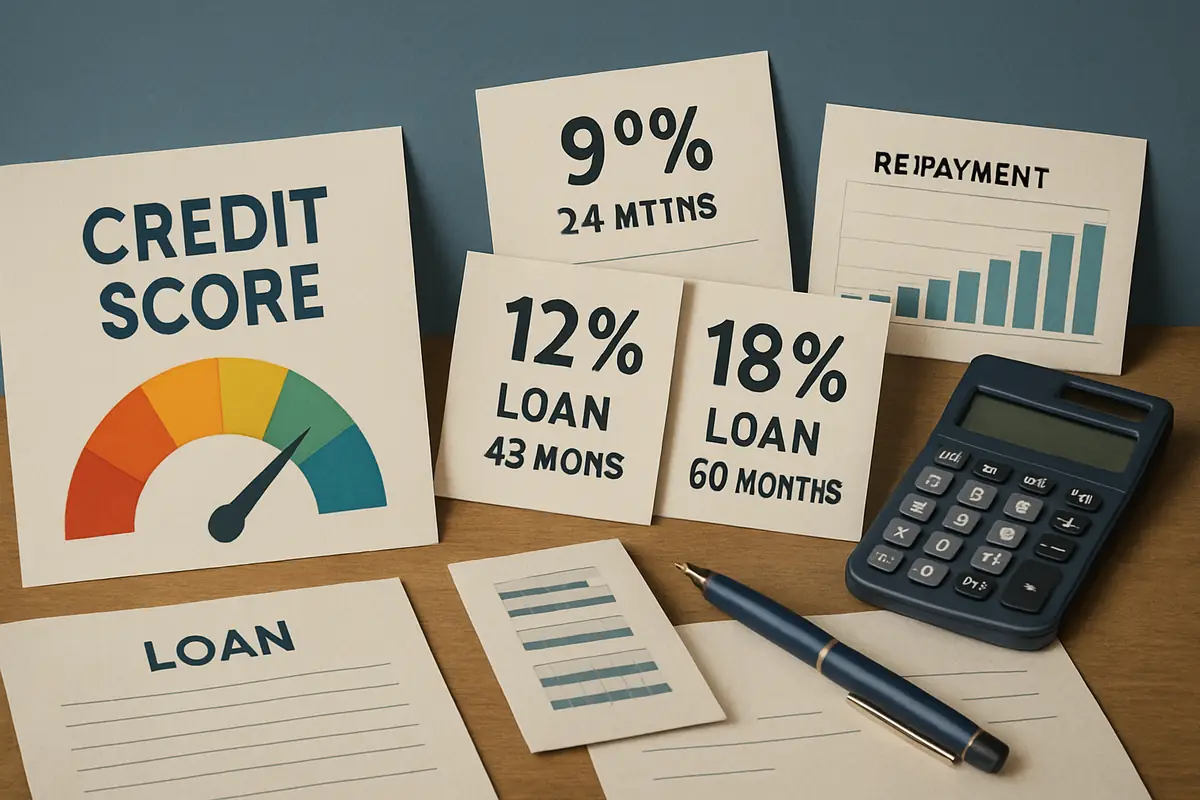
Interest rates play a central role in determining both monthly payments and the total cost of a loan. Fixed rates offer payment stability but can start higher—commonly 6%–10% for personal loans—whereas variable rates may begin as low as 4%, but can rise to 12% or more if market rates increase. Borrowers who assume variable rates will remain low may face payment jumps of $50–$200 per month on a $20,000 balance if rates climb.
Fees are equally influential. Origination fees (typically 1%–5% of the loan amount), late payment penalties (often $25–$40 per missed payment or 5%–10% of the overdue amount), and monthly service fees can add thousands to the total repayment over time. For example, a loan may advertise a 7% APR but not include a $40 monthly administrative fee, which, over a 3-year term, adds $1,440 to the overall cost.
How this can look in practice
Consider Sarah, who took a $12,000 personal loan at an advertised APR of 6% over 36 months. She overlooked a clause imposing a $30 monthly service fee after the first year and a 3% penalty on late payments. When her budget tightened and she missed a payment, the penalty added $360 to her balance, and the extra fees increased her total repayment by $720 over two years—turning an expected $1,140 in interest into $2,220 in additional costs.
Worked Calculation Example: Suppose you borrow $10,000 at a fixed 8% APR for 36 months. Your monthly principal and interest payment is about $313. If the loan also has a $30 monthly service fee, your true monthly payment is $343. Over 36 months, that's $1,080 in extra fees. The total interest paid is approximately $1,268, so with fees, your total repayment rises from $11,268 to $12,348—a 10% increase over the expected cost.
Collateral Requirements Reshape Repayment Flexibility and Risk
Secured loans—those backed by collateral such as vehicles or property—often offer interest rates 2–4 percentage points lower than unsecured loans because the lender’s risk is reduced. However, collateral introduces significant consequences. If a borrower misses payments, the lender can seize and sell the asset, sometimes with as little as 30 days’ notice, to recover the outstanding debt. This process can escalate quickly if the contract allows for accelerated repayment or immediate asset liquidation after default.
Many borrowers assume collateral simply means lower rates, but the stakes are higher: losing a car or home can disrupt employment or living arrangements. Deciding between secured and unsecured loans means weighing interest savings—potentially $1,500–$3,000 over a typical 3-year auto loan—against the risk of losing essential assets if financial difficulties arise.
Repayment Pressure and Penalties Can Escalate Costs Quickly
Repayment pressure arises from more than just monthly installments. Contracts often stipulate penalties for missed or partial payments, which can compound rapidly. For example, a $35 late fee plus a 5% surcharge on the overdue amount can turn a single missed $400 payment into a $455 obligation within 30 days. Some lenders apply daily penalty interest, causing debts to snowball if not addressed promptly.
Step-up payment schemes—where payments start low and increase over time—are sometimes embedded in auto or personal loans. A borrower might begin with $250 monthly payments that rise to $350 by year three, adding $1,200 in extra outlays over the loan term. Without careful review, borrowers may be caught off guard by these increases, especially if their income does not keep pace.
Where readers should be careful
Be cautious of offers advertising 'flexible' repayment schedules without clear boundaries. Such flexibility may conceal aggressive penalty structures, with fees that can exceed 10% of the overdue balance and compound the longer payments are missed.
Digital Tools Are Transforming Repayment Management
Technology is reshaping how borrowers interact with their repayment schedules. Digital platforms can automate reminders, enable online payment adjustments, and provide real-time visibility into outstanding balances. Mobile apps often include budgeting tools and alerts, helping borrowers track due dates and avoid missed payments. However, while these tools increase transparency, they do not alter contractual obligations: a missed payment still triggers fees and potential credit score impacts.
Automated payments can reduce the risk of forgetting due dates, but they may also lead to complacency about reviewing contract terms. For instance, if a lender increases a variable rate from 5% to 8%, automated payments might rise from $300 to $340 monthly on a $15,000 loan, with little warning beyond a digital notice. Digital convenience should supplement—not replace—thorough contract review.
Traditional and New Repayment Models: Stability Versus Flexibility
Traditional loans feature fixed installment schedules—such as $400 per month for 60 months—with clear maturity dates. In contrast, emerging models include income-driven repayments, where payment amounts adjust based on a set percentage (often 10%–20%) of the borrower’s discretionary income, or peer-to-peer loans with individually negotiated terms.
Income-responsive models can extend repayment periods from the typical 5–7 years up to 20–25 years, especially for student loans. While this lowers monthly payments—sometimes to as little as $100–$200—it can increase total interest paid over the life of the loan by thousands of dollars. Borrowers expecting to be debt-free within a decade may find their obligations stretching much longer than anticipated if their income remains modest.
Key Trends That Are Changing Repayment Schedules
Several trends are reshaping how repayment schedules are structured. Since 2010, there has been a notable rise in loans with variable rates, now common in both mortgages and personal loans. Digital lending platforms have also accelerated the adoption of automated payment features and customizable schedules. In the last five years, income-driven and flexible repayment options have expanded beyond student loans to personal and small business lending, providing alternatives for borrowers with irregular income streams. Meanwhile, regulatory changes have pushed lenders to disclose all fees and penalties more transparently, though borrowers must still read contracts carefully to spot potential pitfalls.
Practical Strategies for Evaluating Repayment Schedules
APR (annual percentage rate) is a key metric—it combines interest and most fees into a single yearly cost—but it does not capture all possible charges. Look for monthly service fees, late payment penalties, and any clauses allowing the lender to change terms. For secured loans, understand what triggers collateral seizure and whether you have any grace period before repossession.
Assess your budget’s resilience: calculate your payment-to-income ratio (monthly payment divided by gross monthly income) and ensure it remains below 15%–20%, even if rates rise or income dips. Simulate scenarios where you miss a payment or face an interest rate hike to see how quickly costs escalate. Before committing, ask for a full copy of the contract and clarify any ambiguous terms.
How this can look in practice
John chose a low-rate loan but did not check the penalty structure for missed payments during a seasonal work slowdown. After missing two payments, he incurred late fees and penalty interest totaling over $300—erasing his savings buffer and increasing his debt load beyond what he had anticipated.
Keep all documentation and communicate proactively with lenders if you anticipate trouble meeting payments. Many lenders offer hardship programs or temporary deferments, but these are often only available if you reach out early and provide documentation.
Where readers should be careful
Beware of aggressive refinancing offers that tout lower rates but extend your loan term by several years. While monthly payments may drop by $50–$100, the extended term can increase your total interest paid by thousands of dollars, outweighing any short-term savings.
Weighing Flexibility Against Long-Term Cost Exposure
Flexible repayment options—such as payment holidays, income-driven adjustments, or extended terms—can ease cash flow in the short term. However, longer repayment periods typically mean more interest accrues. For example, stretching a $10,000 loan from 3 to 6 years at an 8% APR increases total interest paid from about $1,280 to over $2,600. Small deviations from the schedule, such as a single missed payment with a $35 late fee and 5% penalty, can snowball if not addressed promptly.
Penalty structures are designed to enforce compliance, but they can quickly multiply costs for borrowers facing temporary setbacks. Understanding these mechanisms is crucial to avoid turning a manageable debt into a persistent financial burden.
Innovative Technologies Are Redefining Repayment Schedules
Technology is rapidly transforming repayment schedules, offering both lenders and borrowers new ways to manage debt. Artificial intelligence (AI) and machine learning enable lenders to analyze real-time income and spending data, tailoring repayment plans to individual cash flow patterns. For example, algorithms can recommend payment adjustments if a borrower’s income drops, reducing the risk of default and helping borrowers avoid costly penalties. Automation streamlines communication, with digital reminders ensuring payments are made on time, reducing reliance on manual follow-up and minimizing missed payments.
Blockchain technology introduces smart contracts, which are self-executing agreements coded to trigger payments automatically when certain conditions—such as receipt of income—are met. This can reduce administrative costs and increase transparency for both parties. Decentralized finance (DeFi) platforms are experimenting with peer-to-peer repayment models, where borrowers and investors agree on tailored terms, potentially lowering interest rates and fees by bypassing traditional banks. These advances may expand access to flexible repayment schedules and foster greater financial inclusion.
Mobile apps are also integral, offering budgeting tools, personalized alerts, and real-time progress tracking. Some apps use gamification, rewarding on-time or early payments with perks or small rebates, which can motivate consistent repayment. Ultimately, technology is making repayment schedules more adaptive, but borrowers must remain attentive to contract details and evolving terms.
The Expansion of Income-Driven Repayment Models
Income-driven repayment (IDR) models are gaining ground, especially in student lending but increasingly in personal and small business loans. Under IDR, payments are set as a percentage—often between 10% and 20%—of discretionary income, which is income left after essential expenses. This structure offers relief during periods of low income, with minimum payments sometimes as low as $50–$100 per month, but may extend repayment periods to 20 or even 25 years. Over time, this can increase the total interest paid, sometimes doubling the original loan cost if income remains low for many years.
IDR models require regular income verification—typically every 12 months—and adjustments if earnings change. This flexibility helps borrowers through job transitions or economic downturns, reducing default risk and supporting long-term financial health. For lenders and governments, IDR can lower default rates in recessions and provide valuable data on borrower behavior. However, borrowers should be aware that extended terms may increase total costs, and any forgiven balances may be treated as taxable income in some jurisdictions.
Environmental and Social Factors Now Influence Repayment Structures
Repayment schedules are increasingly shaped by environmental, social, and governance (ESG) criteria. Lenders may offer special terms—such as grace periods or payment deferrals—during natural disasters or public health emergencies, supporting borrowers without imposing immediate penalties. Green loans, which finance energy-efficient or environmentally friendly projects, may offer interest rate reductions of 0.5%–1% or extended terms if sustainability milestones are met, aligning financial incentives with environmental goals.
Social impact bonds and community development loans sometimes feature repayment terms linked to achieving social outcomes, such as job creation or educational attainment. These structures may include deferred payments or reduced rates if agreed-upon benchmarks are reached, blending financial and societal benefits. As a result, borrowers increasingly seek lenders who incorporate ESG values into their products, valuing flexibility and support during unforeseen hardships.
Effective Ways to Navigate New Repayment Options
With the growing complexity of repayment schedules, borrowers must stay informed and proactive. Before selecting a loan, use digital calculators to model various scenarios—such as interest rate increases, income drops, or temporary payment pauses—and assess how each would affect your total repayment and monthly budget. Understanding how variable payments or performance-based incentives impact long-term costs is crucial.
Regularly review your repayment plan, especially after major life changes like a job switch or unexpected expenses. If difficulties arise, contact your lender early to explore hardship programs or restructuring options—many lenders offer temporary payment reductions or deferrals, but only if you act before missing payments. Maintaining thorough documentation and staying updated on regulatory changes can help you identify new flexible options as they become available.
Ultimately, informed borrowers who actively manage their repayment schedules—by understanding all costs, monitoring their budgets, and communicating with lenders—are better positioned to build strong credit profiles and access favorable loan terms in the future.
References
- https://studentaid.gov/manage-loans/repayment/plans
- https://www.consumerfinance.gov/consumer-tools/student-loans/
- https://www.consumerfinance.gov/consumer-tools/
- https://www.consumerfinance.gov/ask-cfpb/what-is-the-difference-between-a-fixed-rate-and-adjustable-rate-mortgage-arm-loan-en-100/
- https://www.fdic.gov/consumer-resource-center/loans