When reviewing loan offers, borrowers face a complex set of variables that determine the real cost and risk of taking on debt. For example, a $20,000 personal loan can cost anywhere from $22,000 to $30,000 or more over its lifetime depending on the lender’s terms, interest rates, and fees. This article breaks down how differences in lender terms affect not just the monthly payment, but also the total expense, risk exposure, and repayment burden for borrowers.
Monthly Payments Reflect Only Part of Borrowing Costs
Borrowers often focus on the monthly payment when evaluating loans, as this amount feels immediate and relevant to their budget. However, this figure alone can be misleading. The monthly payment is shaped by several factors: the principal (the initial amount borrowed), the interest rate (the cost of borrowing money, typically expressed as an annual percentage rate or APR), the loan term (how long you have to repay), and any fees or insurance premiums included in the payment. For example, auto loans may range from 36 to 84 months, and the difference in term can significantly affect both monthly and total costs.
Relying only on the monthly payment may cause borrowers to overlook critical contract elements such as APR, origination fees (often 1% to 8% of the loan amount), collateral requirements, and penalty clauses. For instance, a 60-month loan at 7% APR will have a lower monthly payment than a 36-month loan at the same rate, but the total interest paid could be hundreds or thousands of dollars greater. Conversely, a shorter term raises monthly payments but reduces overall interest expense, which can be a deciding factor for borrowers seeking to minimize total outlay.
Core Components That Determine Monthly Payment Amounts
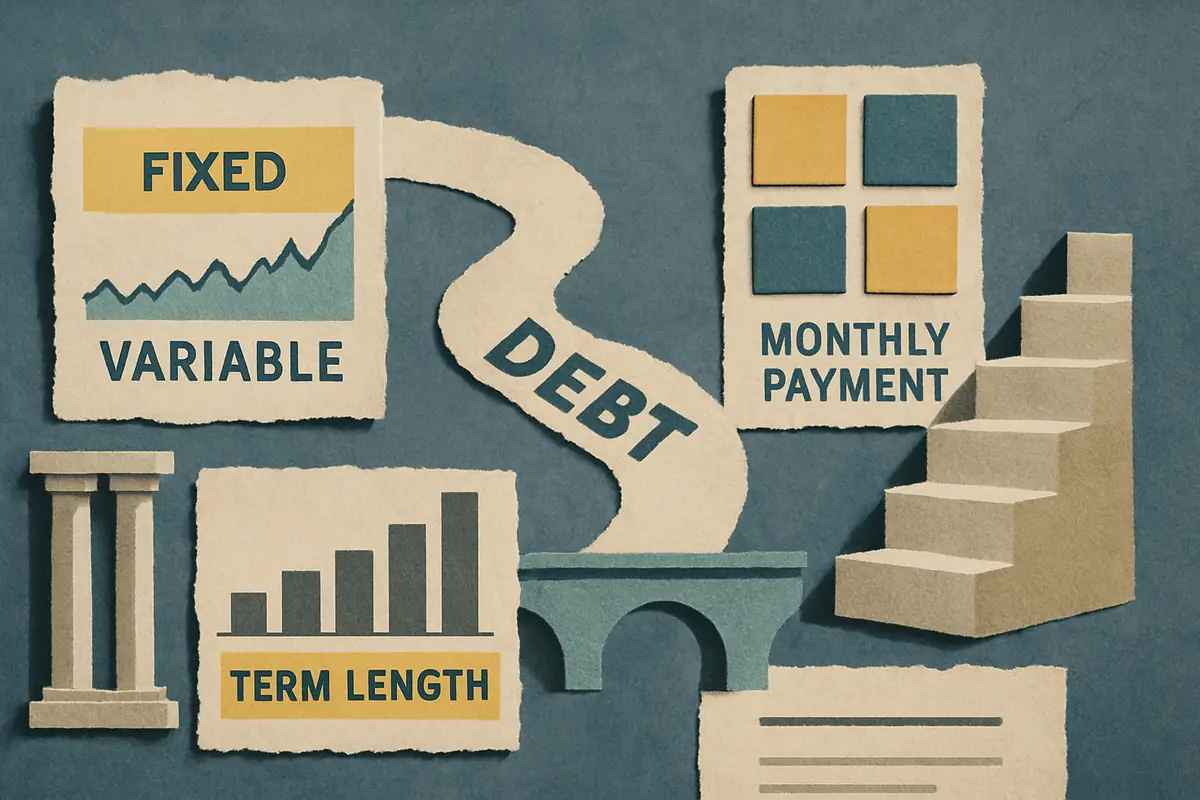
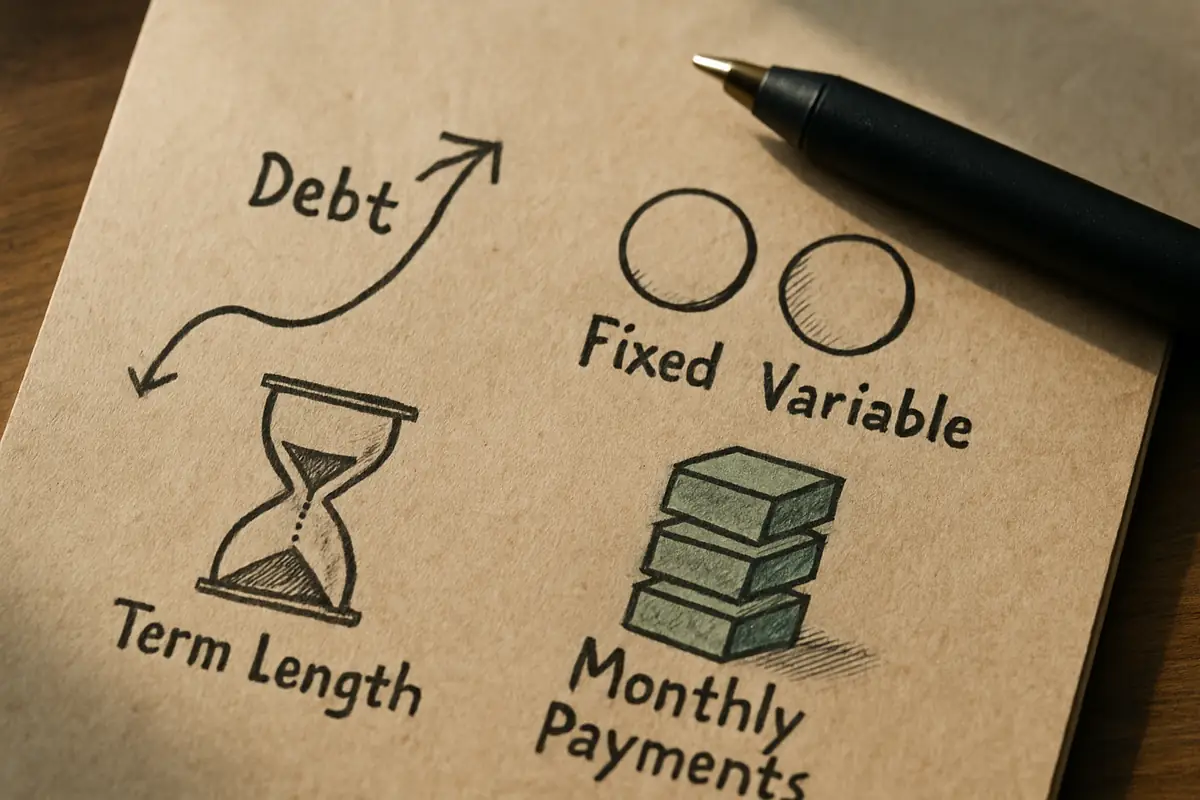
Several elements combine to set a loan’s monthly payment. The principal is the initial sum borrowed. The interest rate—expressed as APR (Annual Percentage Rate), which includes both the nominal interest and mandatory fees—reflects the full yearly cost of borrowing. The loan term is the time allotted for repayment, often ranging from 1 to 7 years for personal loans, and up to 30 years for mortgages. Additional fees, such as origination or administration charges, may be included in the monthly payment or collected upfront.
For example, two lenders might offer $15,000 loans with similar monthly payments, but one includes a 3% origination fee ($450) and the other does not. One lender may require collateral, such as a vehicle, which increases risk if the borrower cannot keep up with payments. Another may have late payment fees of $25 to $50 per occurrence, or prepayment penalties of 2% of the outstanding balance if paid off early. These differences can shift the true cost and risk profile of the loan, even when monthly payments appear similar.
| Factor | What It Means | Risk to Borrower |
|---|---|---|
| APR | Annual Percentage Rate: the total yearly cost of borrowing, including interest and mandatory fees | Can obscure real cost if fees are not fully disclosed; misleading if compared only to nominal rate |
| Fees | One-time or recurring charges such as origination, processing, or late fees | Unexpected or hidden fees increase total repayment |
| Term Length | How many months or years the borrower has to repay | Longer terms lower monthly payments but increase total interest paid |
| Collateral | Assets pledged as security for the loan | Risk of losing property if unable to repay |
| Penalties | Charges for late payments, missed payments, or early repayment | Can add significant cost if financial circumstances change |
APR Provides a More Accurate Comparison Than Advertised Interest Rates
The Annual Percentage Rate (APR) is a standardized measure that includes both the nominal interest rate and most mandatory fees, allowing borrowers to compare offers on an equal basis. However, some lenders advertise only the nominal rate, which may appear low—sometimes as little as 4% to 7% for highly qualified borrowers—while burying fees in the fine print. Typical APRs for unsecured personal loans range from 6% to 36% depending on creditworthiness.
Failing to compare APRs can lead borrowers to select loans with seemingly attractive monthly payments that ultimately cost more due to hidden fees or higher rates. For example, a loan with a 7% nominal rate and $600 in fees may have a true APR of 9% or more. By focusing on APR, borrowers can better identify which offers are genuinely cost-effective over the life of the loan.
Loan Term Length Significantly Affects Total Cost and Monthly Payment
Extending the loan term (the repayment period) reduces the monthly payment by spreading the principal and interest over more months. For example, a $10,000 loan at 8% APR over 3 years has a monthly payment of about $313 and total interest of roughly $1,270. The same loan over 5 years drops the monthly payment to about $203, but total interest jumps to around $2,180. This trade-off means borrowers must balance short-term affordability with long-term expense.
Shorter terms increase monthly payments but reduce exposure to interest and allow borrowers to become debt-free sooner. For example, a 15-year mortgage will have higher monthly payments than a 30-year mortgage, but the total interest paid could be tens of thousands of dollars less. Borrowers should consider their income stability and long-term financial goals when choosing a loan term.
How this can look in practice
Suppose two borrowers each take a $20,000 loan at 6% APR.
- Borrower A selects a 5-year (60-month) term: monthly payment is about $386; total interest paid is approximately $3,160.
- Borrower B chooses a 7-year (84-month) term: monthly payment drops to about $293; total interest paid rises to approximately $5,620.
Borrower B’s lower monthly payment comes at a cost of $2,460 more in total interest over the life of the loan.
Collateral Requirements Increase Borrower Risk and Limit Flexibility
Secured loans, such as auto loans and mortgages, require collateral—an asset pledged as security for repayment. Collateral can result in lower interest rates, sometimes by 2% to 6% compared to unsecured loans, but puts the borrower’s property at risk if payments are missed. For example, failing to pay a secured $15,000 auto loan could result in repossession of a vehicle worth several thousand dollars. Unsecured loans typically have higher APRs (often 10% to 36%) but avoid this risk.
Collateralized loans can also complicate refinancing or resale, as the lender may require full repayment if the asset is sold or transferred. Borrowers must weigh whether the benefit of a lower monthly payment is worth the risk of losing valuable assets in case of unexpected financial hardship.
Penalty Clauses Can Add Significant Costs
Many loans include penalty clauses for late payments, missed payments, or early repayment (prepayment). Late fees typically range from $15 to $40 per occurrence, and some lenders charge 2% to 5% of the overdue amount. Prepayment penalties—charged if the borrower pays off the loan early—can be 1% to 3% of the outstanding balance. These charges may go unnoticed if borrowers focus only on the scheduled monthly payment.
Penalty clauses can quickly escalate the cost of borrowing. For example, missing two payments on a $10,000 loan with a $35 late fee each time adds $70 to the debt, not counting additional interest or potential credit score impacts. Understanding the full penalty schedule is essential before committing to a loan.
Repayment Pressure Goes Beyond the Monthly Installment
Repayment pressure is the overall burden of keeping up with scheduled payments, especially if income is variable or unexpected expenses arise. Even loans with low monthly payments can become unaffordable if penalties are triggered or collateral is at risk. For example, if a borrower’s income drops by 20% for several months, maintaining a $400 monthly loan payment may require dipping into savings or missing other obligations.
Stress-testing loan scenarios—such as simulating a temporary income loss or emergency expense—helps borrowers anticipate how manageable payments will be in real life. Over 40% of borrowers report facing unexpected expense challenges during repayment, while nearly 30% underestimate penalty costs, and about 35% of defaults are linked to over-reliance on low monthly payments rather than total loan cost.
Effective Steps for Comparing Lender Offers
To accurately compare loan offers, borrowers should take several practical steps:
- Review full disclosure documents, not just marketing materials, to identify all fees and penalties.
- Calculate total loan cost using APR, which incorporates interest and required fees.
- Analyze how different term lengths affect both total repayment and monthly affordability.
- Examine collateral requirements and assess personal risk tolerance for asset loss.
- Scrutinize penalty schedules for late, missed, or early payments to anticipate future liabilities.
For instance, a borrower comparing two $10,000 personal loans with similar monthly payments may discover that one lender’s late payment penalty is $40 while the other’s is $15. If the borrower misses two payments, the higher-penalty loan adds $80 in fees, significantly increasing the total cost.
How this can look in practice
A borrower considering two personal loans finds both offer $250 monthly payments. However, one loan includes a 4% origination fee and $35 late payment penalty, while the other has no origination fee but a $50 late penalty. After missing one payment, the second loan becomes more expensive overall, despite similar monthly installments.
Advertised Offers Often Omit True Borrower Costs
Loan advertisements typically show the best-case scenario—minimal rates, ideal credit score assumptions, and no penalties or extra fees. In reality, only borrowers with excellent credit (often FICO scores above 750) qualify for the lowest rates, and many applicants see higher rates or additional fees. Some offers exclude origination fees (commonly 1%–5%) or assume no late payments, which may not reflect a borrower’s actual experience.
Borrowers should carefully review eligibility requirements, such as minimum income or credit score thresholds, and ask lenders for a detailed breakdown of all costs. This ensures that quoted payments are realistic for their specific situation and not just an idealized estimate.
Where this helps
- Advertised payments offer a quick way to estimate affordability.
- Allow borrowers to screen multiple lenders efficiently.
Where caution is needed
- May omit variable costs that raise true repayment amount.
- Can mislead borrowers into accepting riskier or more expensive loans.
Refinancing Changes Monthly Payments and Total Loan Costs
Refinancing—taking a new loan to pay off an existing one—can lower monthly payments, often by extending the term or reducing the interest rate. For example, refinancing a $25,000 auto loan from 8% to 5% APR can save $30 to $60 per month, but may increase the total interest paid if the term is extended. Borrowers should carefully evaluate new terms, including any new fees or penalties, as well as the impact on their credit utilization ratio (the percentage of available credit being used), which can affect credit scores.
It’s important to ensure that the benefits of a lower monthly payment outweigh the potential increase in total repayment and any new risks introduced by the refinance agreement.
Credit Scores Drive Lender Offers and Monthly Payment Amounts
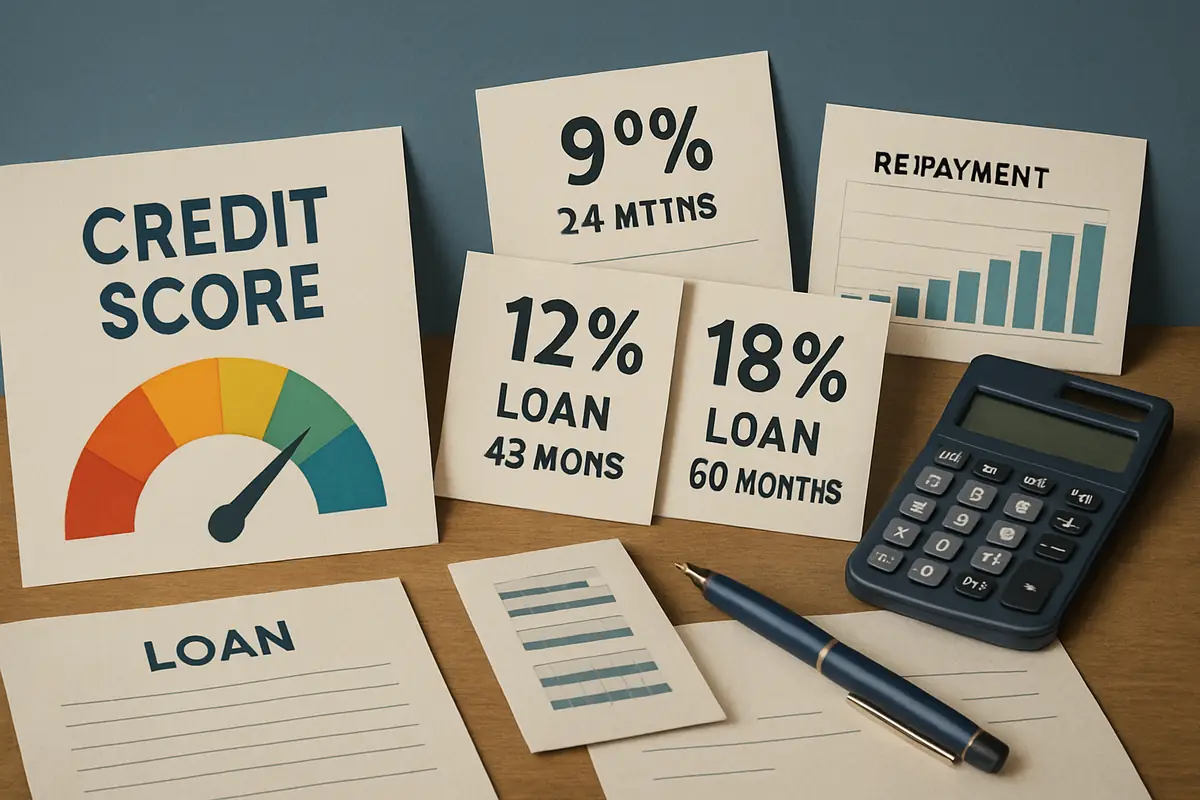
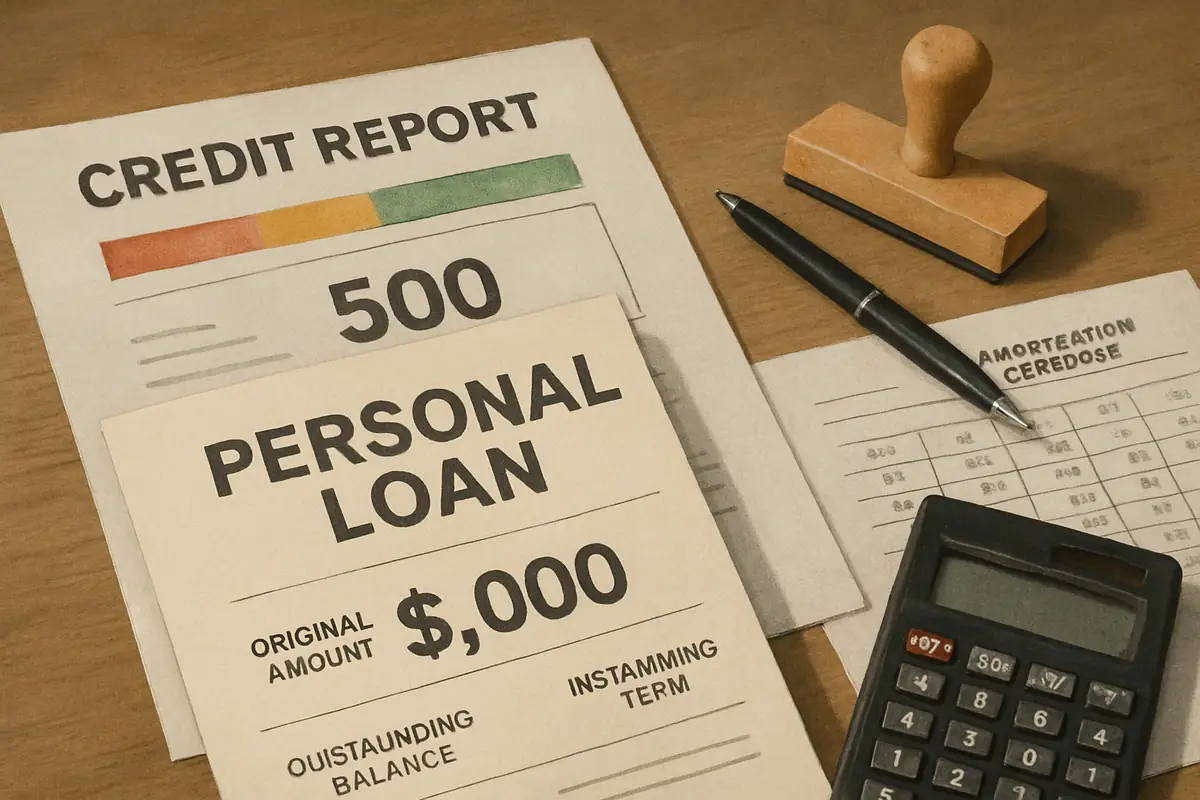
A borrower’s credit score—a three-digit number reflecting credit history and repayment behavior—directly affects the interest rate and terms offered by lenders. Higher credit scores (typically 700 or above) can unlock APRs as low as 6% to 10% for personal loans, while scores below 650 might result in rates of 18% to 30% or higher. This difference can mean a monthly payment that is $50 to $150 higher on a $10,000 loan, and thousands more in total interest over the loan’s life.
For example, two borrowers each seeking a $15,000, 5-year loan may receive offers at 7% and 18% APR, respectively. The borrower with the lower rate pays about $297 per month and $2,800 in total interest, while the higher-rate borrower pays $381 per month and more than $7,800 in interest. Reviewing and improving one’s credit score before applying can lead to substantial savings.
Loan Terms and Repayment Schedules Directly Shape Monthly Obligations
Loan terms—such as the number of months for repayment and the structure of the repayment schedule—directly influence both monthly payments and total cost. Longer terms (e.g., 72 or 84 months) reduce monthly payments but increase total interest, while shorter terms (e.g., 24 to 36 months) raise monthly payments but decrease total cost. Amortization, the process by which each payment covers both interest and principal, means that early payments primarily pay interest, with more principal paid off in later periods.
Consider two lenders offering $20,000 loans: one with a 3-year term, the other with a 5-year term. The 3-year loan might require a $600 monthly payment and cost $1,800 in interest, while the 5-year loan’s $400 payment results in $4,000 in interest. Borrowers must weigh their monthly cash flow needs against the desire to minimize total repayment.
Fees Beyond Interest Rates Affect What Borrowers Really Pay
In addition to interest, lenders often charge fees that impact both upfront and ongoing costs. Common examples include:
- Origination fees: 1%–8% of the loan amount, deducted before funds are disbursed
- Prepayment penalties: 1%–3% of the remaining balance if paid off early
- Late payment fees: $15–$50 per missed payment
- Administrative fees: Flat charges, sometimes $50–$100, for processing
For instance, a $10,000 loan with a 5% origination fee means the borrower receives $9,500 but must repay the full $10,000 plus interest. Over a 5-year term, this fee alone adds $500 to the total cost. Some lenders also charge annual fees or require credit insurance, further increasing the monthly and total repayment burden.
Loan Type Determines Payment Structure and Flexibility
Different loan types have varying structures that affect monthly payments. Mortgages, for example, often use amortization schedules over 15 to 30 years, resulting in fixed or adjustable monthly payments. Auto loans typically last 36 to 72 months, with fixed payments. Personal loans usually have terms of 24 to 60 months and fixed rates, while credit card debt is revolving with variable minimum payments based on balance and interest rate (commonly 18%–30% APR).
Student loans may offer income-driven repayment plans, where monthly payments are set at 10% to 20% of discretionary income and can change annually. Understanding the payment structure and flexibility of each loan type helps borrowers choose the best fit for their financial situation and anticipate how payments may change over time.
Strategic Approaches for Comparing Lenders Effectively
To maximize value and minimize risk when comparing lenders, borrowers should:
- Request personalized quotes using identical loan amounts and terms to ensure fair comparisons.
- Use online calculators to model how different rates, fees, and terms affect both monthly and total payments.
- Negotiate for better terms, such as reduced fees or more flexible repayment schedules, especially if credit is strong.
- Consult financial advisors or credit counselors for objective guidance on complex decisions.
For example, comparing three lenders for a $12,000, 4-year loan might reveal monthly payments ranging from $290 to $350, with total costs from $13,900 to $16,800 due to differences in APR and fees. Running these scenarios helps clarify which offer aligns best with both short-term affordability and long-term financial health.