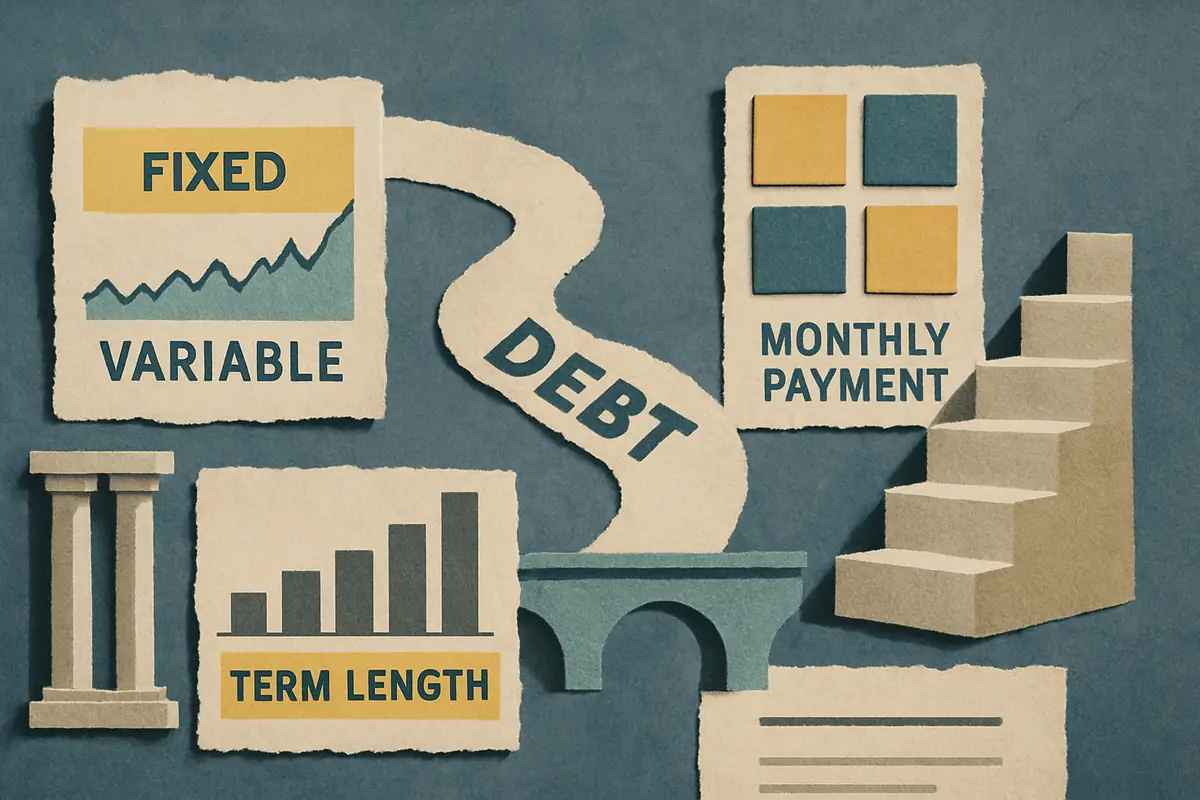
A loan agreement is not just a promise to return borrowed funds; it is a legally binding contract that spells out each party’s rights, remedies, and responsibilities under both expected and unexpected scenarios. This includes how interest accrues, what happens if payments are missed, and the steps taken if either party defaults.
Understanding the legal structure before signing is an essential part of responsible borrowing. Overlooking a single clause can result in unexpected costs or legal action years later.
Today, with digital contracts accepted in minutes and funds sometimes deposited within 24 hours, the pressure to sign quickly is higher than ever. This makes careful legal review even more important, as haste can obscure details that impact your finances long after the funds are spent.
Loan Contracts Are Built to Manage Future Disagreements
A well-structured loan contract does more than set repayment terms. It anticipates scenarios such as late payments, changes in interest rates, activation of guarantees, and disputes over interpretation. For example, a personal loan for $10,000 over 48 months might seem straightforward, but the contract will address what happens if payments are delayed by more than 30 days, or if one party wants to repay early.
This is why contracts use precise language, even for seemingly simple loans. Legal terms define not just the agreement, but also the process for resolving disagreements that might arise months or years into the repayment period.
Most borrowers focus on the basics:
- Principal amount (the initial sum borrowed, e.g., $5,000 or €20,000)
- Monthly installment (often $200–$1,500 for consumer loans)
- Interest percentage (such as 5% to 25% APR)
But equally important are legal clauses that address:
- Default consequences (e.g., extra interest of 2%–5% per month on overdue amounts)
- Acceleration clauses (the lender can demand the full balance if you miss 2–3 payments)
- Penalty conditions (fees up to $50–$100 per late payment)
- Dispute jurisdiction (which court will resolve conflicts—local or national)
Borrower Protections Exist Only When Understood and Exercised
In many countries, lending is governed by a mix of civil law, consumer protection statutes, banking regulations, and sector-specific rules. For example, in the European Union, consumer credit directives require lenders to provide clear pre-contractual information, while in the U.S., Truth in Lending laws set standards for disclosure.
This legal framework means borrowers are not without protection. However, these protections are only effective if the borrower understands and asserts them before signing. For instance, you have the right to receive a standardized summary of key loan terms before committing, but if you sign without reviewing this document, you may lose leverage in future disputes.
Transparency obligations require lenders to disclose all essential economic consequences—such as the total repayment amount, fees, and interest—so borrowers can compare offers. Typical disclosure includes the annual percentage rate (APR), total interest paid over the loan term, and any mandatory insurance or administrative costs.
APR Is a More Comprehensive Legal and Financial Cost Indicator Than Nominal Interest
Many borrowers focus only on the nominal interest rate (the base yearly rate charged for borrowing), but the annual percentage rate (APR) is the more meaningful figure. APR represents the total yearly cost of borrowing, including interest, fees, commissions, and mandatory charges, expressed as a percentage of the loan amount.
- Interest (e.g., 7% per year)
- Commissions (origination fees of 1%–5% of the loan amount)
- Administrative charges (such as $100–$300 for processing)
- Mandatory expenses (like required insurance, often $10–$30 per month)
A loan with a nominal interest rate of 6% but a $500 origination fee and $20 monthly account maintenance fee can have an APR of 8%–10%. This means the real cost of borrowing is higher than the nominal rate suggests.
Calculation Example: Suppose you borrow $10,000 at a nominal interest rate of 6% for 3 years (36 months), with a $300 origination fee and $10 monthly maintenance fee. The total interest paid over 3 years is about $950. Adding the origination fee ($300) and maintenance fees ($360), the total cost becomes $1,610. The APR, which reflects all these costs, will be closer to 8.2%, not 6%.
This is why APR is central to consumer credit transparency and should be the primary figure used when comparing loans. For credit cards, APRs commonly fall between 18% and 30%, while personal loans may range from 6% to 36% APR depending on creditworthiness.
The Parties Involved Directly Affect Legal Risk
Not all lenders are subject to the same legal obligations. Borrowing from a regulated bank or credit union is different from arranging a loan with a private individual or company. For example, regulated financial entities are typically subject to government oversight, while private lenders may not be.
Regulated Financial Entity
- Higher supervision (regular audits and compliance checks)
- Standardized transparency duties (mandatory disclosure of APR and fees)
- Formal complaint channels (ombudsman or regulatory authority)
Private Lending Arrangement
- More flexible drafting (terms can be negotiated case by case)
- Lower procedural safeguards (fewer protections if disputes arise)
- Greater drafting responsibility (borrower must verify all terms)
A private loan can be legally valid and useful, but vague or incomplete contracts often lead to disputes. For example, if a $5,000 private loan lacks clear terms on repayment schedule and interest, disagreements can escalate to legal action, sometimes costing more than the original loan amount.
In private agreements, clarity is critical because enforcement depends entirely on what is written. Courts will typically enforce only what the contract states, not what the parties assumed.
Guarantees Extend Legal Obligations Beyond the Main Borrower
Many borrowers underestimate the legal impact of guarantees. A guarantor (sometimes called an "avalista") is someone who promises to repay the loan if the main borrower defaults. This is not a symbolic gesture; it is a binding legal obligation.
If the primary borrower misses payments, the guarantor can be required to pay the full remaining balance, sometimes within 30 days of default notification. For example, on a $20,000 loan, the guarantor may be pursued for the entire outstanding amount, not just a portion.
Guarantors must understand:
- Whether liability is full (the entire balance) or limited (up to a set amount)
- Whether the lender can claim immediately after default or must first exhaust remedies against the main borrower
- The duration of the guarantee (some remain enforceable for up to 5–10 years)
Solidary Liability and Shared Liability Have Distinct Legal Consequences
When multiple borrowers sign a loan, the structure of liability is crucial. "Solidary liability" (also called joint and several liability) means each borrower can be held responsible for 100% of the debt, not just their share. In contrast, "shared liability" means each person owes only their agreed portion, such as 50% each on a two-person loan.
For example, if three friends co-sign a $9,000 loan with solidary liability, the lender can demand the entire $9,000 from any one of them if the others do not pay. With shared liability, each is responsible for $3,000.
This distinction is especially important in family loans, joint purchases, and co-signed obligations. Many borrowers assume responsibility is automatically divided, but legally, solidary clauses are common and can have significant consequences if one party defaults.
The Cooling-Off Period Offers a Legally Protected Window for Reconsideration
Consumer lending laws in many jurisdictions grant a cooling-off period—typically 14 days in the EU and 3–7 days for some U.S. loans—during which borrowers can withdraw from the contract without penalty.
This right exists because lawmakers recognize that decisions made under urgency or sales pressure may not reflect a borrower’s best interests. The cooling-off period allows time to review the agreement and seek advice if needed.
However, studies show that fewer than 10% of borrowers exercise this right, often simply because they are unaware it exists. If you have second thoughts within the cooling-off period, you can cancel the loan and return any funds received, usually without additional cost.
Abusive Clauses Can Be Hidden in Standard Language
Not all unfair contract terms are obviously aggressive. Many appear as standard clauses but shift significant risk or cost to the borrower. For example, penalty interest rates on missed payments can reach 20%–30% annually, and automatic maturity clauses can trigger full repayment after a single missed installment.
Other examples include unilateral modification rights (allowing the lender to change terms without consent) and excessive early repayment penalties (sometimes 2%–5% of the outstanding balance).
- Excessive penalty structures (late fees exceeding $50 per occurrence)
- Automatic maturity triggers (full balance due after 1–2 missed payments)
- Unilateral modification rights (lender may alter interest rate with 30 days’ notice)
While courts can invalidate abusive clauses, prevention is better than litigation. Identifying problematic terms before signing is the most effective protection.
Quality Documentation Supports Approval and Legal Security
Borrowers sometimes see documentation as a bureaucratic hurdle, but it is central to both approval and legal clarity. Providing clear, consistent documents—such as income verification (recent pay stubs or tax returns), proof of identity (government-issued ID), and evidence of residence (utility bills)—reduces the risk of delays and disputes.
- Income proof (last 2–3 months’ payslips or tax returns)
- Identity consistency (matching names and dates across documents)
- Debt exposure visibility (listing all debts for accurate assessment)
- Residence verification (utility bill dated within last 60 days)
For example, incomplete documentation can delay approval by 1–2 weeks, or even result in rejection. Clear records also serve as evidence if legal questions arise later.
Notarial Intervention Strengthens Legal Certainty in Major Loans
For significant loans—especially mortgages and real estate financing, which often exceed $100,000—formal notarial involvement is required in many jurisdictions. This process is not ceremonial, but a legal safeguard.
A notary’s role includes:
- Verifying the identity of all parties (preventing fraud)
- Explaining contract clauses in plain language
- Granting the document "executory force" (making it immediately enforceable in court without further litigation)
This notarial process increases legal certainty for both borrower and lender. For the borrower, it ensures that the contract’s implications are explained clearly and that all legal requirements are met before signature.
Careful Reading Is the Foundation of Legal Protection
While modern lending platforms emphasize speed—sometimes approving and funding loans in under 48 hours—legal security is built on patience and attention to detail. Rushing through a contract increases the risk of overlooking costly clauses.
A borrower who reviews each section carefully will understand:
- Which costs are fixed (e.g., interest rate fixed at 7% for 60 months)
- Which costs may vary (variable rates or fees after introductory periods)
- What happens in case of payment delays (late fees, penalty rates, potential default after 2–3 missed payments)
- Which rights remain protected (such as the right to early repayment without penalty after a set period)
The legal dimension of borrowing is inseparable from the financial one. It determines whether the loan remains fair and manageable if circumstances change—such as job loss, illness, or rising interest rates. Taking the time to read and understand every term is the best way to ensure your financial agreement protects your interests, not just at signing, but throughout the life of the loan.